Vince Gilligan's Pluribus
A Cry for Help

Bennett’s Phylactery, Chimping is as Real as Voting:
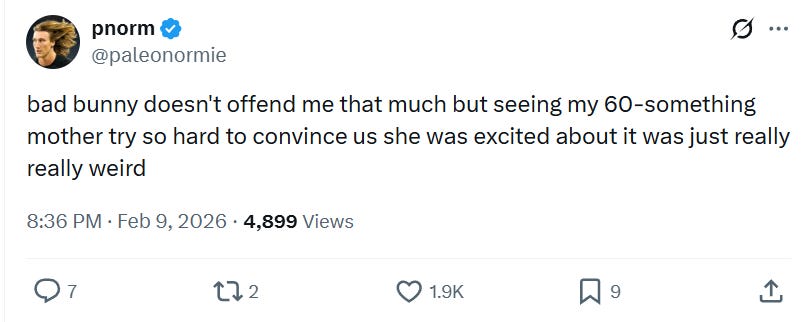
“Many of us have learned how painful it is to argue with an elderly loved one about politics: “you are arguing with the TV, and the TV can’t hear you and doesn’t care.”
It’s a cute turn of phrase, but it doesn’t really capture the dawning horror and anguish as you realize that you are no longer talking to your intimate relative: you are talking to Stephen Colbert.
And you can’t just say, “Sorry Stephen, I’d like to talk to my dad now” — what Stephen has to say is Very Important and he’s Deeply Concerned and he’s not going anywhere.
It’s not that it’s so unbearable to disagree: it’s the feeling that an alien presence has insinuated itself into your closest relationships.
Friends and loved ones whom you like and value for all sorts of human reasons are now separated from you by an impassable gulf. And for what?
Your dad isn’t going to change anything. His opinion doesn’t matter. In the aggregate, of course, these mass media campaigns work, but your dad’s contribution to the whole is infinitesimal. They parasitized his mind (and your relationship) to buy themselves one vote, out of 152 million: 0.000000657% of the objective.
The logic of mass democracy demands this, of course — power is officially vested in The People, and every election cycle it must be gathered in again to the organs of government. The state can’t just extract your dad’s passive obedience: they need to manufacture his enthusiastic (ideally, pissed-off and righteous) consent.
The side that refuses to consume your dad’s mind in this way will be defeated by the side that does so with vampiric hunger.”
—Bennett’s Phylactery, Chimping is as Real as Voting
“Chimping” is as real as voting - by Bennett’s Phylactery
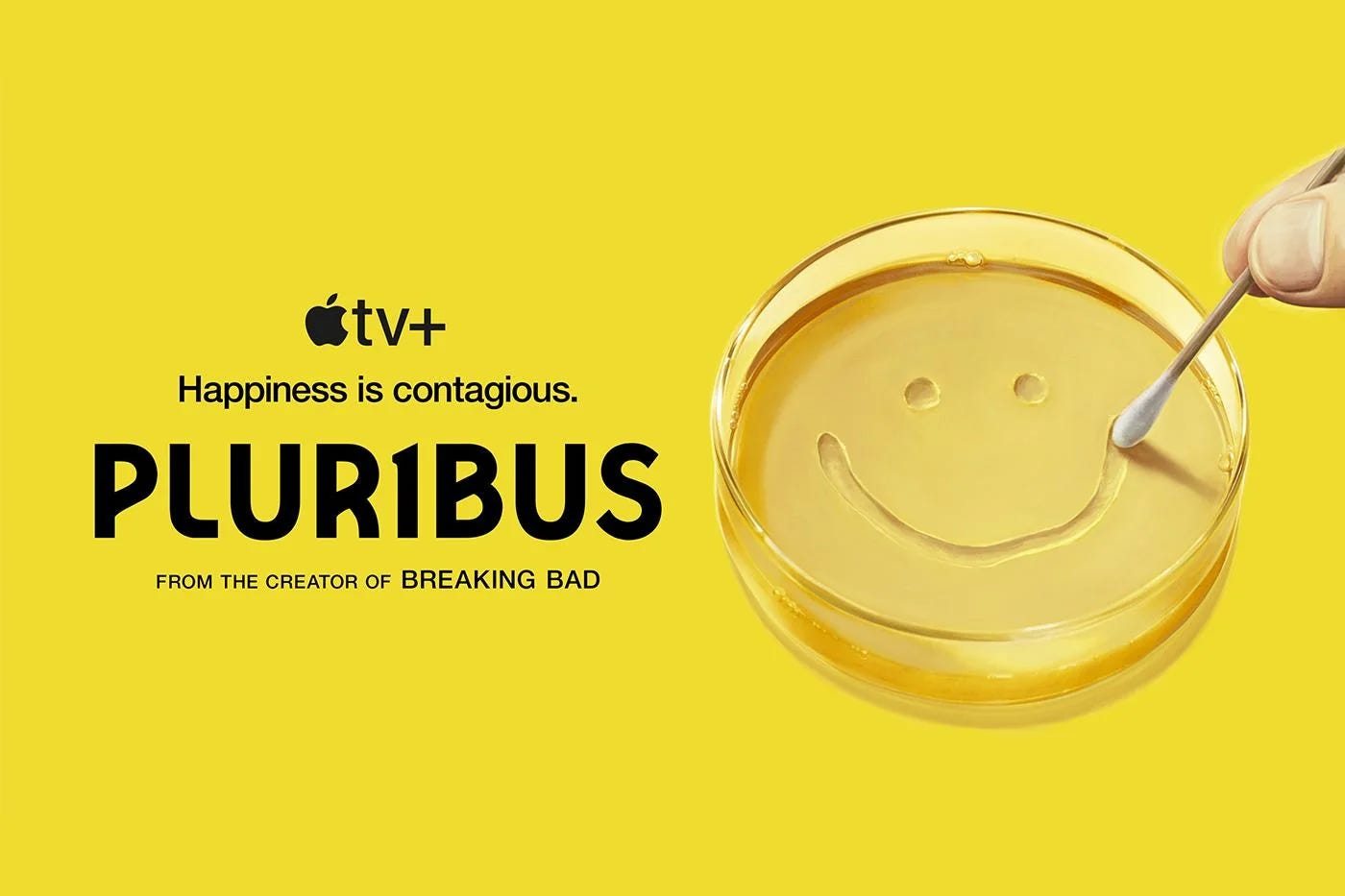
Vince Gilligan, the creator of Breaking Bad and Better Call Saul, has returned to his science fiction roots with a new television show called “Pluribus”. Vince Gilligan began his screenwriting career as a writer on the X-Files, where he wrote 30 episodes and was a co-executive producer on another 40+ episodes, and the premise of “Pluribus” fits in neatly with his speculative origins. The Latin phrase “E Pluribus Unum,” means “out of many, one,” and has been one of the foundational mottos and philosophical creeds of the American experiment since the beginning. In this instance, the titular “Pluribus” refers to a psychic alien hivemind that cordycepts the human species, unifying all of mankind under a shared thought process.
There’s a slight catch.
All of humanity has been unified, and colonized — except for eleven rare, isolated individuals. Our heroine is Carol Sturka, a woman who thinks for herself. She’s a contrarian.
That’s where the first episode begins.
The story starts out with a sense of realism, and dense technical hard sci-fi, delving into broadcast signals, satellites, viral RNA sequences, advanced mathematics, and the transmission of a contagion in order to give the narrative a sense of grounded, plausible verisimilitude. After the science has been established, flooding the audience with an appropriate level of technocratic mumbo jumbo, the narrative shifts away from technical details, and concentrates more on the emotional engine that made Breaking Bad such a beloved, enduring, remarkable, critically-acclaimed success: human emotion, suspense, procedural narratives, and the drama of watching resourceful underdogs struggle against the overwhelming danger of conspiracies funneling vast macroeconomic forces against a hero.
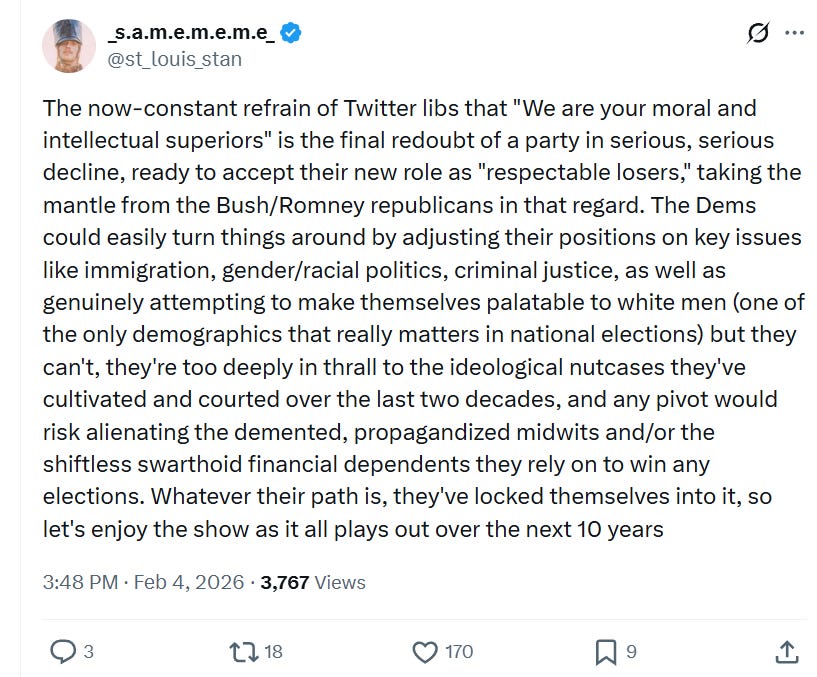
My main takeaway from watching this show is that: it’s impossible to create beautiful art that adheres to the philosophical aspirations, assumptions, proclivities, and constraints of Wokeness, Leftism, egalitarianism, Gay Race Communism, or whatever else we want to call the Woke Mind Virus.
“Impossible” is a strong word. Maybe it’s not technically “impossible”, simply extremely difficult, but at some point there becomes no functional difference between making something illegal, versus adding so much excess friction that a normal, previously-effortless process becomes impractically expensive, time-consuming, and painful while nominally keeping it accessible to anyone who wants it badly enough to suffer an extended journey of discomforts.

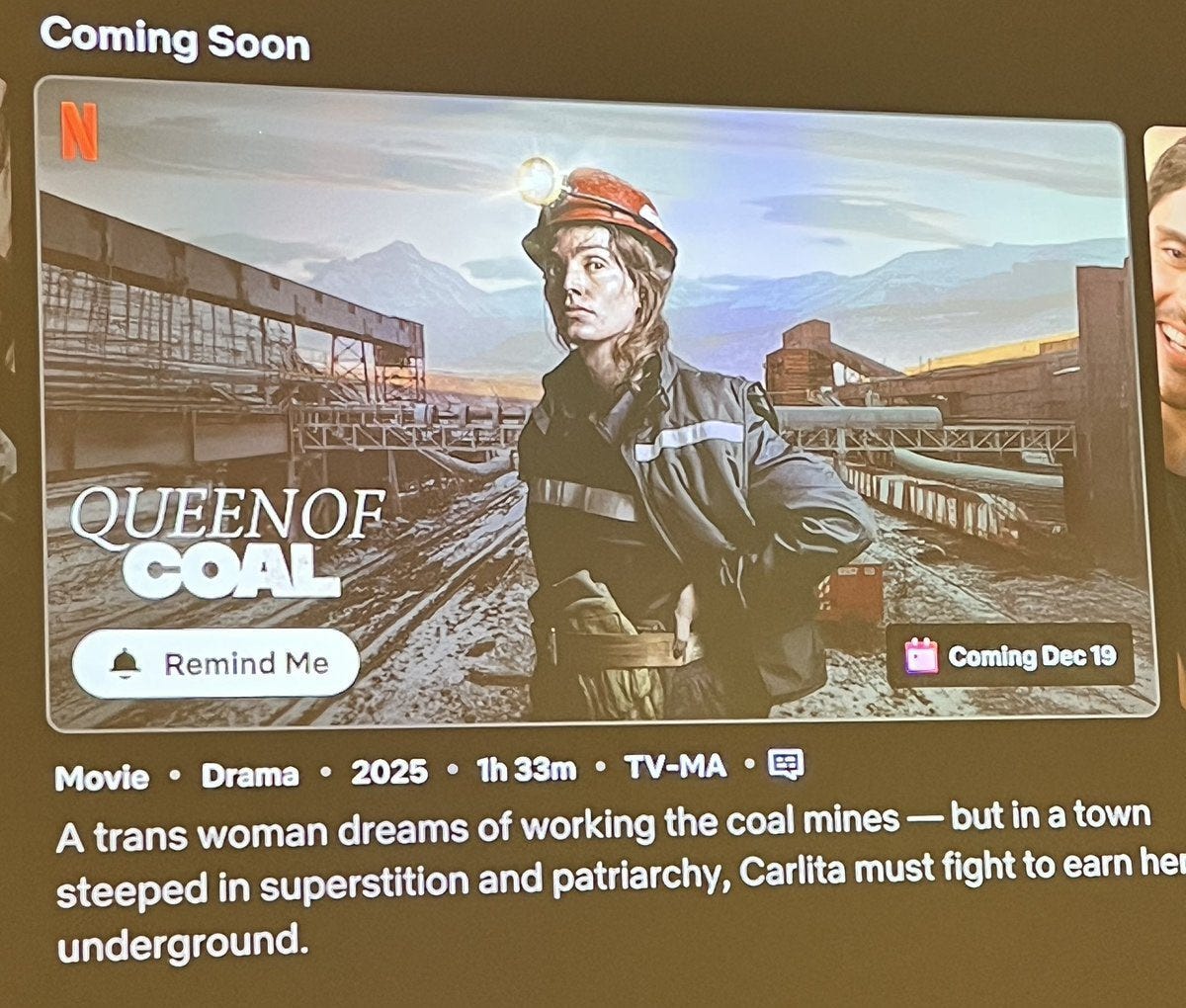
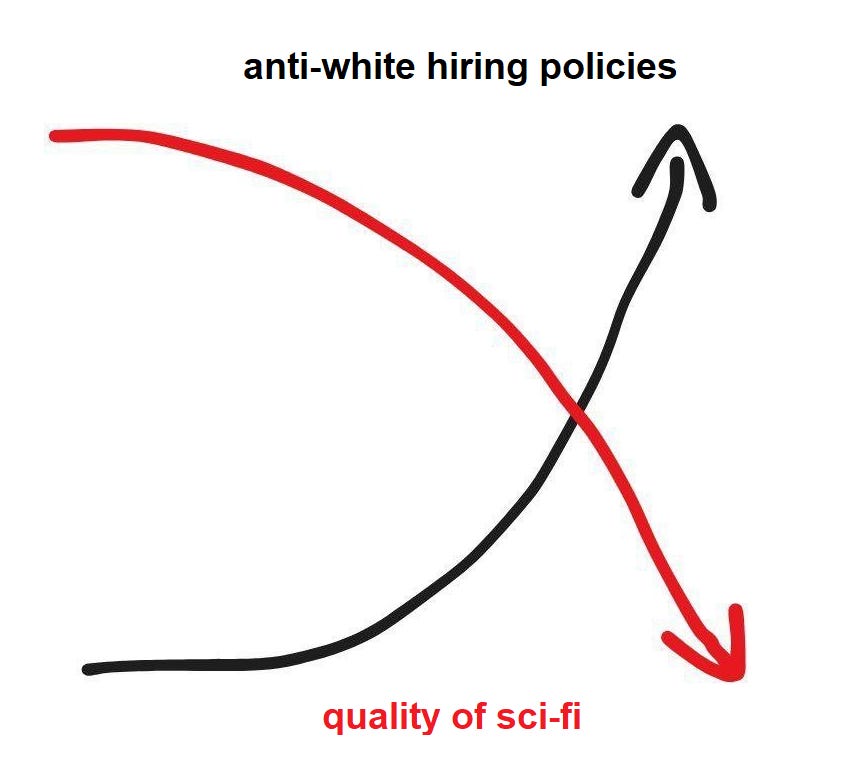
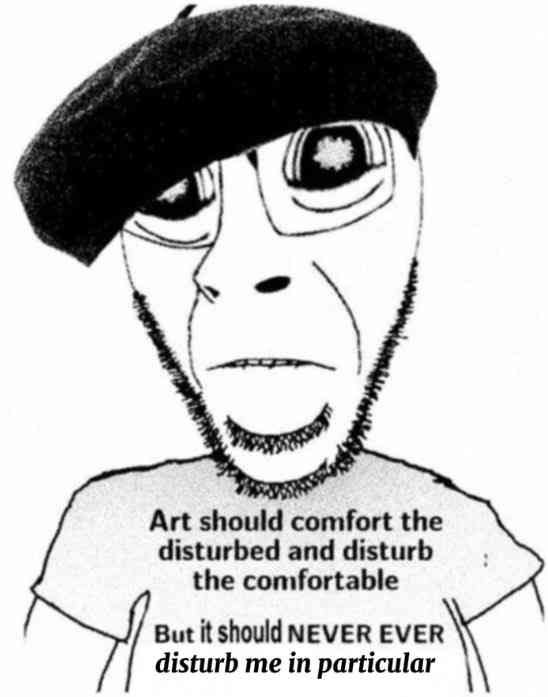

All of the best scenes in the show “Pluribus” were the moments that had nothing to do with Wokeness, when Leftism was offscreen or reduced to the margins of the narrative. There were a lot of cool scenes, cool moments, cool setpieces, but they were fun and cinematic in an old-fashioned, anachronistic way, predating the current hysteria of our time.
For a guy like Vince Gilligan (born in 1967, three years short of being a Boomer), it makes sense to play along with the current political insanity infesting every part of elite institutions, especially infesting Hollywood. He’s an old white guy, which is bad under the framework of modern Leftism. But he’s an old white guy, which means that none of this really personally impacts him as long as he mouths the words and pays lip service to the religion of our time. Negative consequences fall on young white men; Vince Gilligan is grandfathered into incredible wealth, luxury, and prestige as someone who was already successful before the latest round of purity spirals (the decade from 2014-2024).
From a materialist perspective, Vince Gilligan should be happy. But watching the show “Pluribus”, it’s obvious that his presence in modern Hollywood is slowly driving him insane, along with everyone else. The narrative is a thinly-veiled, barely-disguised allegory for his own life: everyone around him has gone crazy and been infected with the alien hivemind of a Woke Mind Virus, which they are trying to convert him to, and although he’s mentally a contrarian who can detach and remain outside of the system, he feels profoundly isolated and powerless. Like our heroine Carol, he has become a spectator to events much bigger than him, and a prisoner of society’s collective delusions.
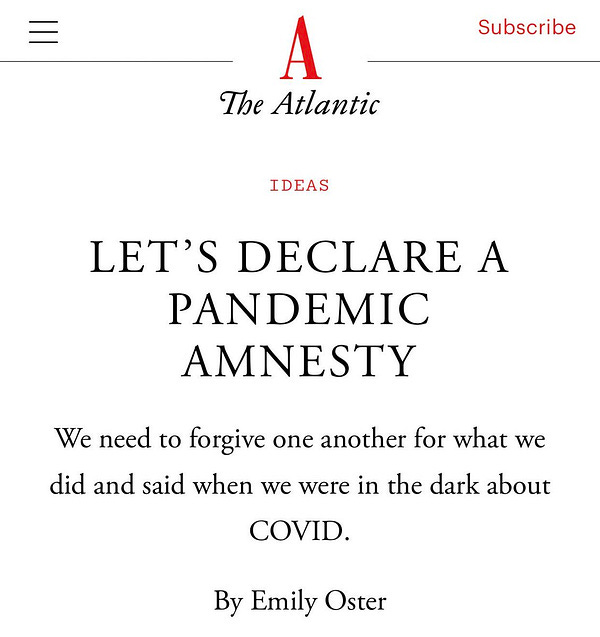
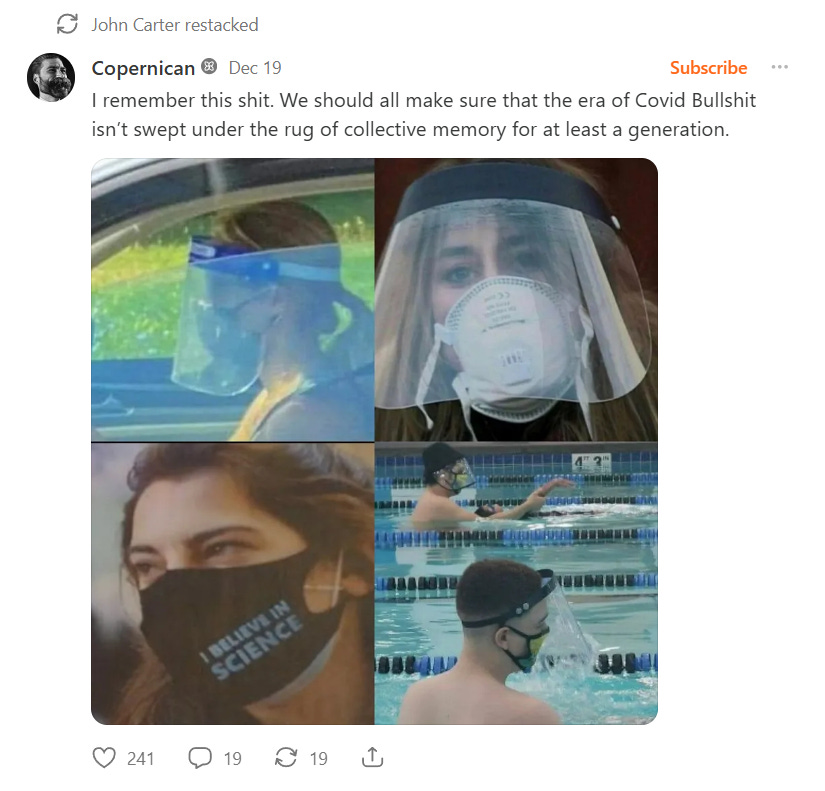
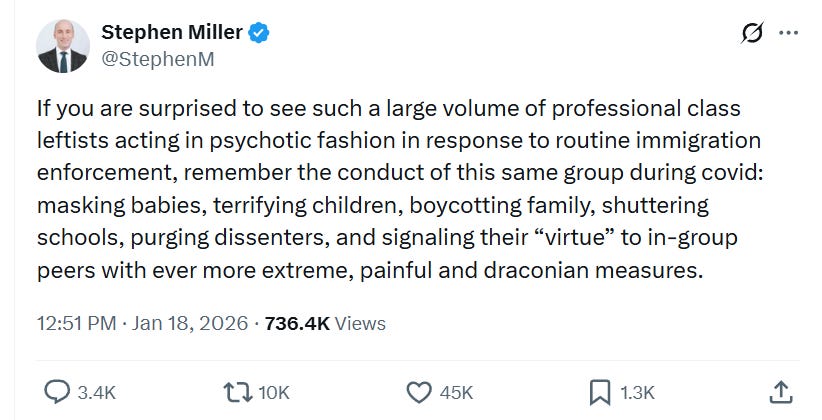
The two ideas that really summarize this show are: the Covid lockdowns, and the NPC meme.
The symbolism is pretty transparent — we all just lived through a global pandemic leaked from a military lab (in Wuhan, China), and Vince Gilligan’s story is about a global pandemic leaked from a military lab. The past ten years of Leftist religious hysteria, the Great Awokening, also parallels the mass hysteria surrounding and crowding out Vince Gilligan’s heroine Carol.
Curtis Yarvin, “The Great Interview with the Organic Intellectual of the Trumpist Counterrevolution”:
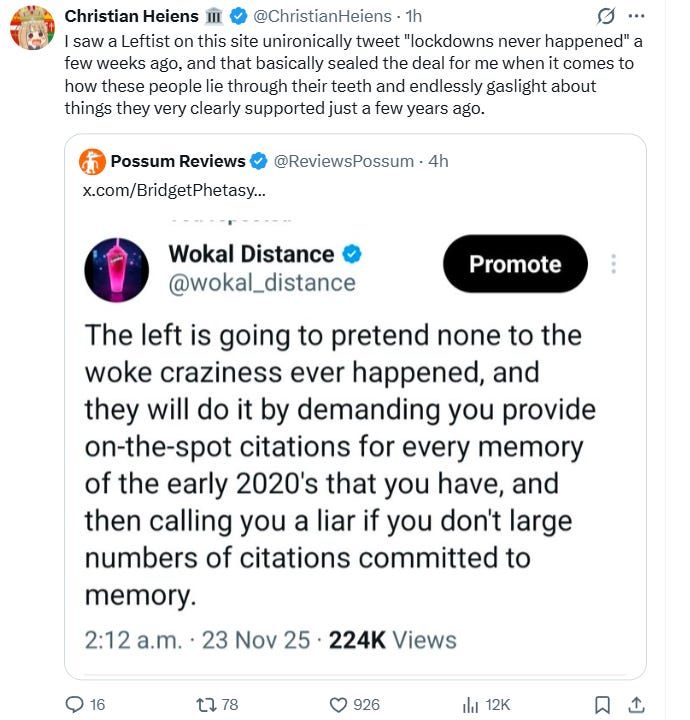
“Covid-19 and George Floyd are happening around the same time.
The George Floyd frenzy is spreading around the world. It’s absolutely incredible. In Iceland, they feel personally concerned by George Floyd. It’s the funniest thing for an American. George Floyd is in France, George Floyd is everywhere. And there’s a historical arc that goes from the Scottsboro Boys case, the Sacco and Vanzetti case, directly to George Floyd. It is the same thing a century apart.
The relationship between George Floyd, “wokism” and the pandemic is relatively subtle.
But I think that Covid allows everything. It allows for a state of emergency. He sweeps away everything in his path.
The pandemic is such a defining moment that one of the most remarkable things for me about the 2024 election is that no one is talking about Covid-19 — not because it’s too insignificant, but because it’s too important.
—Curtis Yarvin, “The Great Interview with the Organic Intellectual of the Trumpist Counterrevolution”

Aly Dee, July 17th, 2024:
“It wasn’t just 2020, it was 2016. Now it’s 2024.
Eight years is a long time to experience social battering for some of you to call for the embracing of cordiality at the end of it.
You cannot fathom the level of anger people have inside of them for being demonized and ostracized. This didn’t just happen with acquaintances and friends, it happened with “families.” Contrary to what you might think, being correct on major cultural conflicts every 18 months after being socially battered does not feel good. It’s not enough to be correct. Some of us (foolishly) want justice that is not likely to occur.
Pivotal life events were canceled, not just due to policy, but due to some of us being nonconforming to the dominant culture.
Let me remind you all what it was like in 2016 and beyond to live as a Conservative in the US of A:
-Weddings and holidays were canceled over politics.
-The elderly died in nursing homes away from family.
-Poor policy led to entire nursing home populations being decimated.
-The unmasked and unvaccinated were blamed for lockdowns.
-The vaccine hurt far more than it helped.
-People lost their livelihoods over supporting Conservative politicians.
-People were bribed to take the vaccine.
-Social media accounts were taken down for “misinformation” later proven to be true.
-Miscarriage rates skyrocketed with the debut of the vaccine and that was considered misinformation.
-Pregnant women were given an experimental medication.
-People were encouraged to stand 6 feet apart arbitrarily.
-People called the police on each other for social gatherings.
-People lost their livelihoods over vaccination status.
-Some states required proof of vaccination to engage in the public sector.
-It was considered a crime to falsify vaccination status.
-Doctors were silenced not just on the vaccine, but other major conflicts such as gender transitioning.
-Women had to give birth ALONE in hospitals.
-Women were separated from their babies in some instances of delivery during the pandemic.
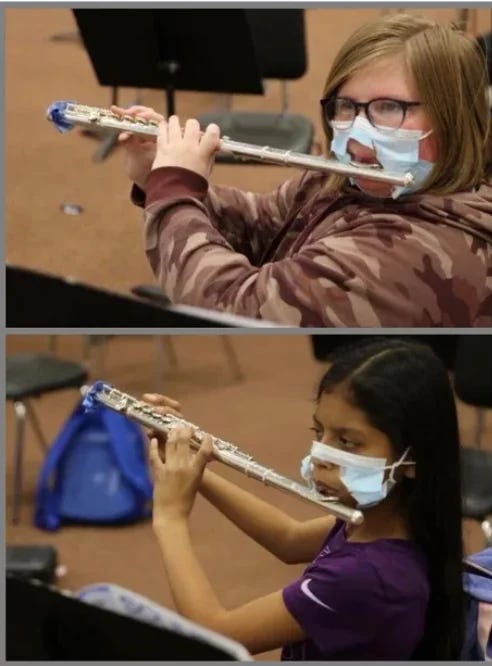
-They made us wear cloth masks with no proven efficacy.
-The lableak theory was regarded as conspiratorial when it came to be the most likely theory.
-The “Summer of Love”
-Kyle Rittenhouse
-Derek Chauvin
-J6 Arrests
-The Left wished death on the unvaccinated.
-A generation of children will become adults who have mutilated genitals. Their romantic lives are over.
-People were told two weeks would be long enough, it became months.
-Some couples divorced from the stress.
-People couldn’t attend funerals for the dead.
-Hospitals overdiagnosed COVID for financial incentive.
-Assassination attempt.
-Trump’s multitude of indictments.
-Gloating of the phrase “convicted felon.”
-Riots on college campuses.
-The rise of anti-whitism.
-People couldn’t see their primary care, who knows how many unchecked illnesses will lead to future deaths because of the shutdown of hospitals and clinics.
-People were kicked out of their education programs.
-Some families had the vaccine injured pass away.
-We were given the choice of a bioweapon and it’s antidote. Terrible dichotomy there.
Conservatives are rightfully furious.
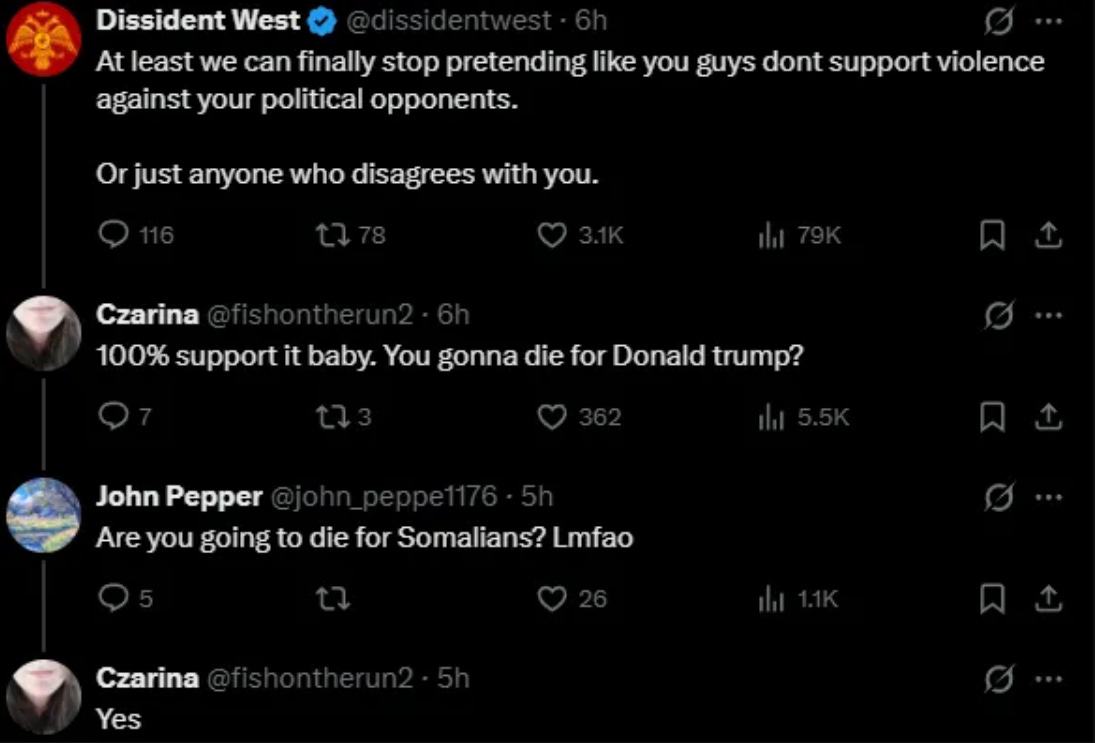
Yes, they will be taking scalps socially. Fortunately, they have etiquette and don’t often bring that anger to the real world in the form of physical violence because we possess a moral compass.
So a midwit libtard won’t be able to call for literal violence online without consequence.
Cry me a river.
Many of you seem to have a short memory.
I have yet to have a single Leftist apologize to me for any of these past events. Not all listed happened to me, but several did. And, you know what, I have to make peace with that. I need to get to a place where I don’t desire something that will never come.
It has been an excruciating 8 years for some of us.
No, it’s not good to hold onto this anger. Yes, we should all seek to let go and let God. But that is far easier said than done.—Aly Dee, July 17th, 2024:
It’s a cry for help.
The whole story is Vince Gilligan trying to process his own suppressed anxieties, by using science fiction as a metaphor for the omnipresent dysfunctions of the current political epoch. And in an indirect way, he’s trying to call attention to how corrosive and counterproductive the current mode of societal behavior is, by symbolically exploring the alien mode of behavior that results in total catastrophic destruction of global civilization… which neatly maps onto Western Civilization’s suicidal death cult paroxysms between the years of 2014-2024.
But it doesn’t really work, because this is a studio project funded by the same system, the same status quo which Vince Gilligan purports to critique, and so rather than bravely speaking truth to power by viciously lacerating the shortcomings, hypocrisies, blind spots, and injustices of the religion of our time — the delusional, egalitarian pursuit of Gay Race Communism — he ends up doing his job as a screenwriter, getting paid to promote all of the luxury beliefs, parasitism, social corrosion, and suicidal death cult delusions which he’s trying to escape, or at least insulate himself from.
Christian Heiens, January 26th, 28th, 2026:
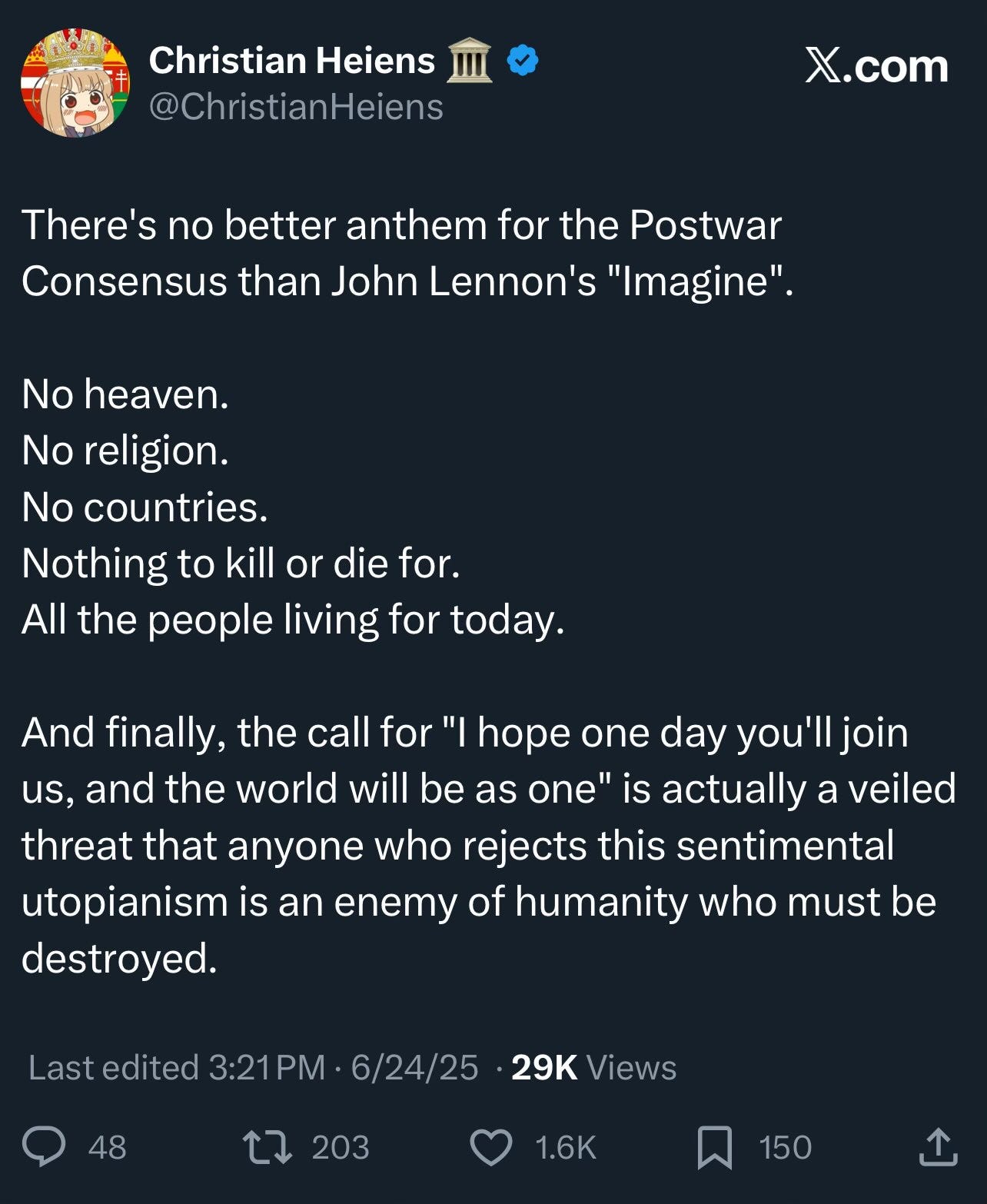
“The story of European civilization since the fall of the Roman Empire has been one long and tragic struggle to discover some neutral ground which can transcend conflict and that everyone can unite around, only for us to later discover that each universalist project we pursue actually creates the very conflict that defines each era.
The Reformation, the Enlightenment, Industrial Capitalism, Nationalism, and Liberalism itself each promised peace through some form of universalism, and each one ended up producing new forms of conflict which dominated the political landscape until a new domain emerged and began the cycle anew.
The last universalist project is modern Liberal Democracy, which is completely exhausted, metaphysically bankrupt, and unraveling in real time. Not even its own defenders promise that it will transcend conflict any longer. They’re instead talking about the need to literally destroy and disenfranchise half the country in the name of defending the very system they once claimed would transcend enmity itself.”….
Christian Heiens, January 28th, 2026:
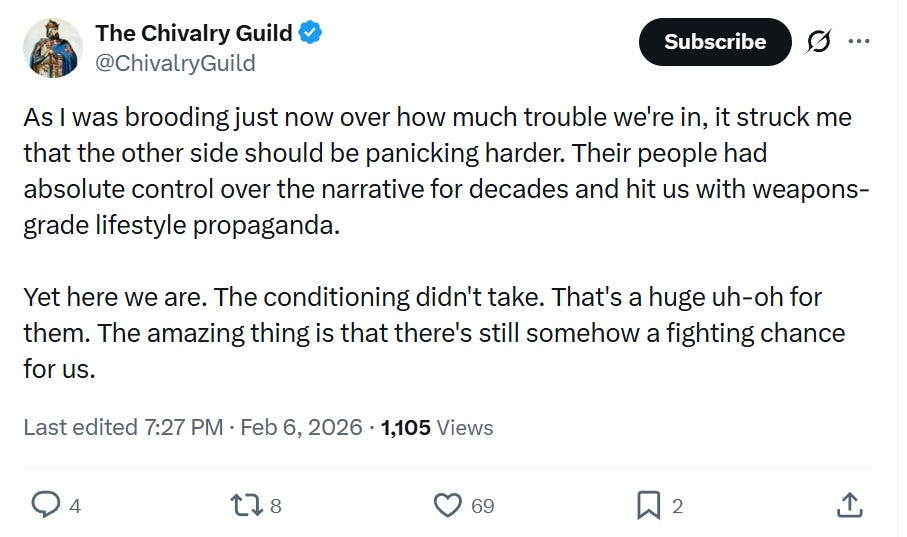
I really don’t think the Left expected the level of pushback they ended up getting after the early 2020s.
These people truly believe destiny is on their side and that the arc of history must bend towards them. They think they hold the Mandate of Heaven and always will. And when you have that mindset, opposition seems as impossible to mount as it is treasonous to entertain.
So when the Left engaged in the Great Awokening of the last dozen years, it was always with the intention that the Right would tag along, just on a delayed timescale.
Conservatives were supposed to get on board with open borders, mass migration, transing the kids, anti-White and anti-Male discrimination as a matter of public policy, and a host of other things...just in a more muted form. They were supposed to be dragged into the gay race communist utopia kicking and screaming, but everyone knew it was all theatrics, and they’d end up going along in spite of their public opposition.
And what ended up playing out was something else entirely, which I still don’t think the Left has fully appreciated even now. Yes, many Republicans still function as controlled opposition. Yes, there are still Beautiful Losers that make up what we call the “Conservative Movement”.
But the general zeitgeist on the Right is one of total disgust and utter contempt for the Left at this point. A decade ago, the stories out of Minneapolis would have prompted almost universal condemnation from the Right and a moral panic that we have to pander to people who we now know openly hate us. And while some Conservatives are doing just that, it’s worth noting how many are saying the exact opposite.
The “End of History” and “Mandate of Heaven” don’t matter to half the populace any longer, and the Left has long since run out of real arguments to make because those psychological tools were sufficiently powerful for so long that their ability to persuade has atrophied.
What’s going to replace this almost mythical narrative is likely to be raw force, at least at first, even as blatant displays of power chip away at the moral legitimacy of the Left even more.”—Christian Heiens, January 26th, 28th, 2026
Upstate Federalist, December 26th, 2025:
“Los Angeles is a factory town whose factory has relocated. Tale as old as time.
L.A.’s entertainment economy is spiraling downward: Work is evaporating, businesses are closing, and the city’s creative middle class is hanging on by a thread.
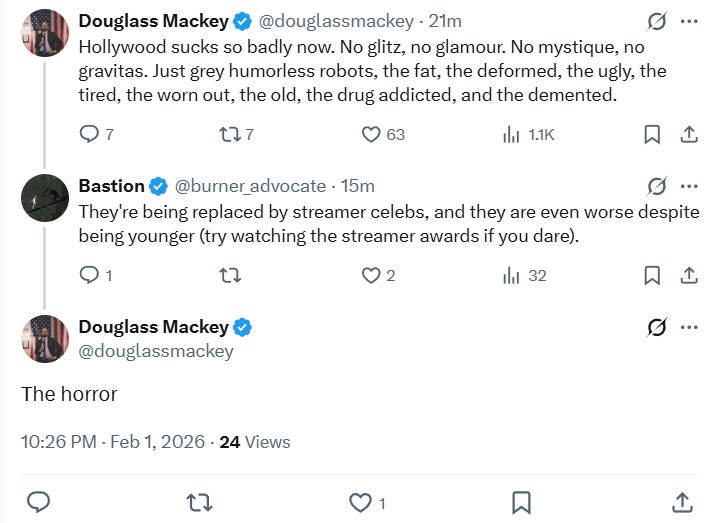
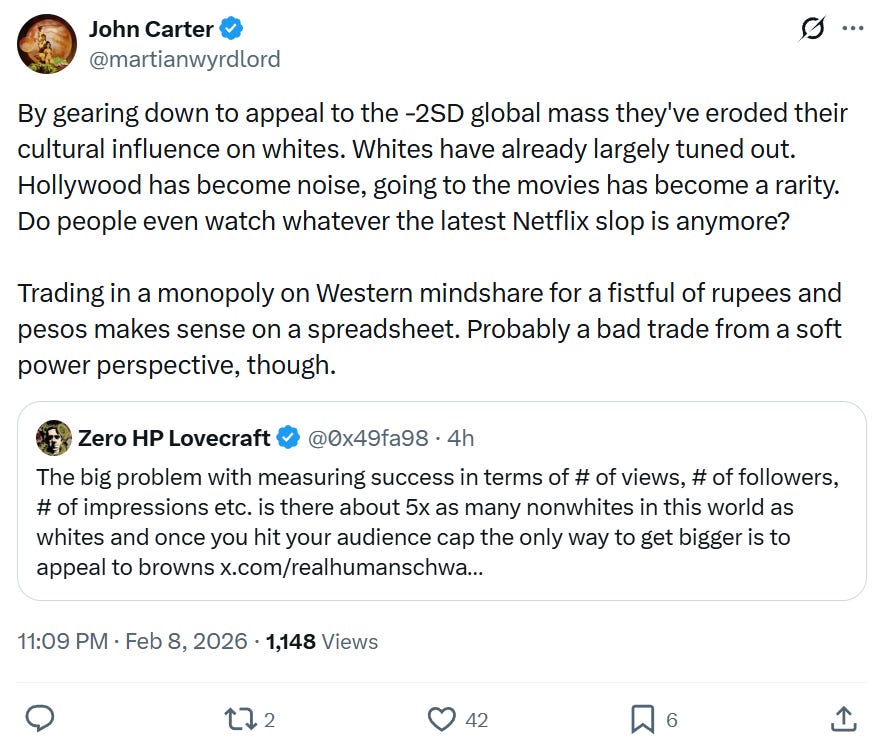
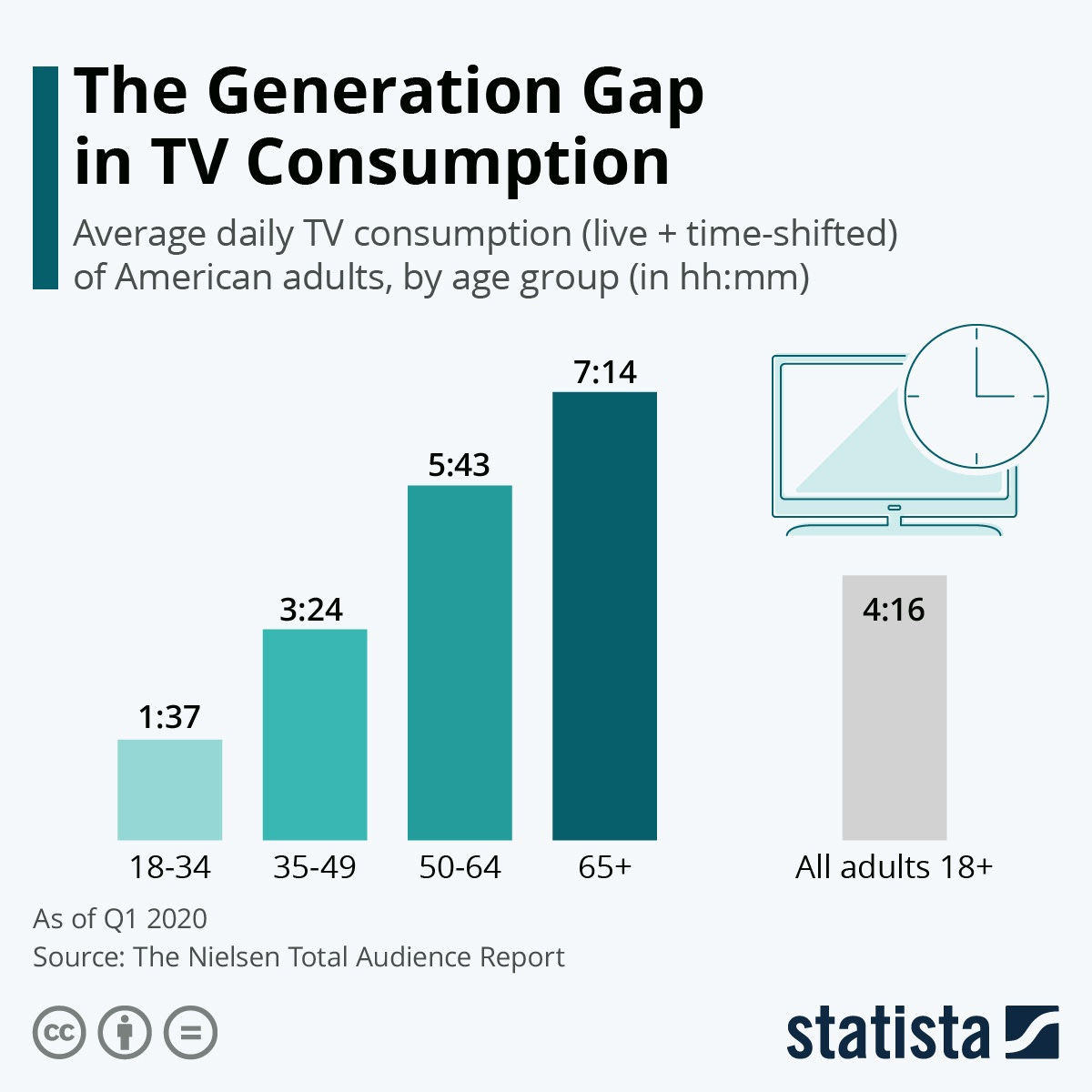
You can’t just infinitely lose money. “TV sucks now” isn’t just a thing old people are saying. TV sucks now.
It seems necessary to remind people that Breaking Bad, Mad Men, Sons of Anarchy, Game Of Thrones, 24, Prison Break, Scrubs, Fringe, CSI, House, and Walking Dead were all TV shows *at the same time.*
Pluribus is probably the only good TV show of 2025 and the vast majority of Americans won’t even get the chance to see it. There’s a Claire Danes/Matthew Rhys show on Netflix that I didn’t even know existed and I 100% would have given it a chance on normal TV.”
—Upstate Federalist, December 26th, 2025
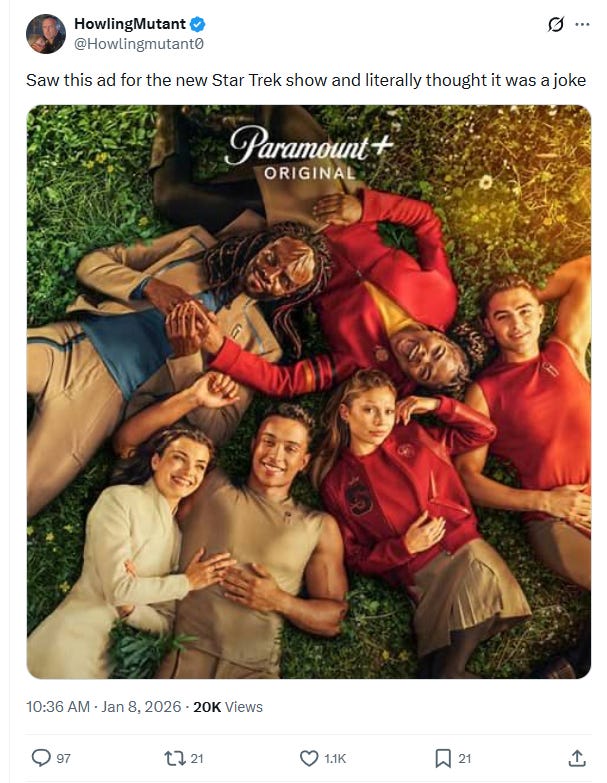
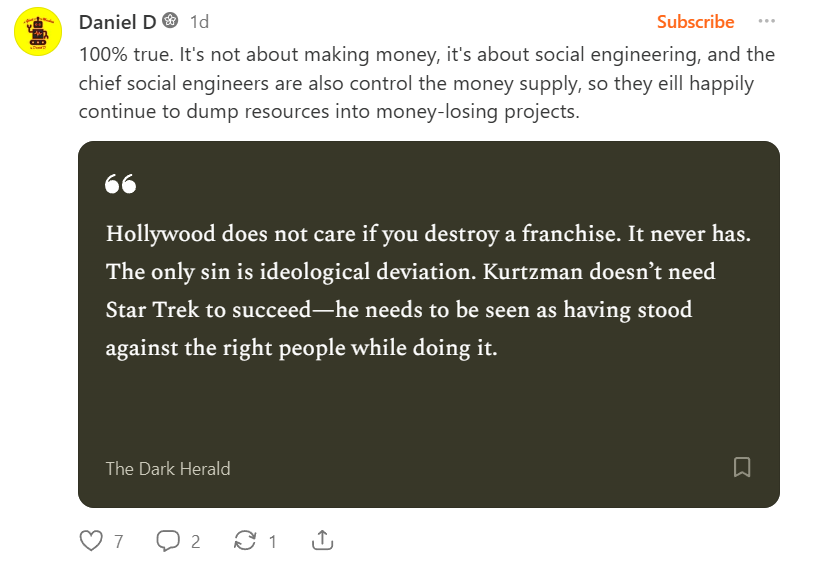
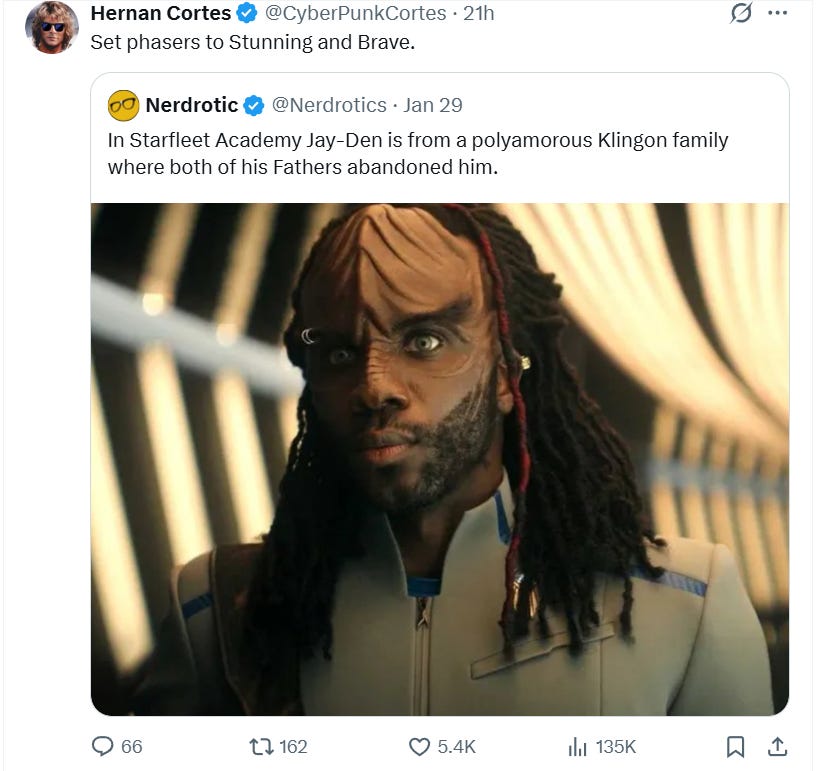

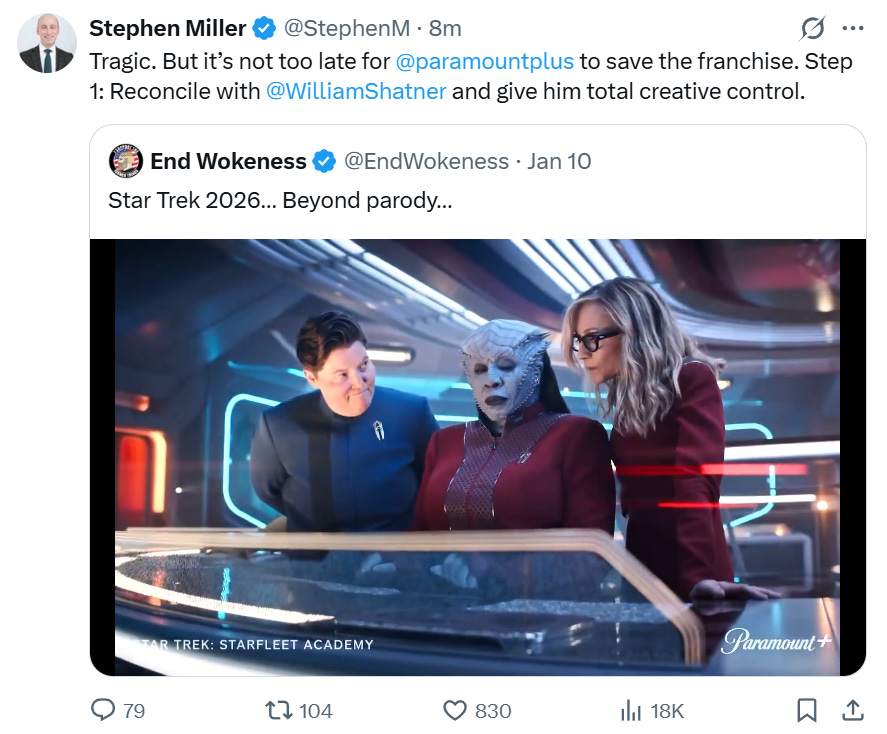
Like the heroine Carol, Vince Gilligan is trapped.
He is powerless; he is a prisoner; he is impotently raging against the system he is dependent upon; he is encircled and swarmed and besieged by vast industrial-scale delusions which he cannot singlehandedly correct. Despite this, his life remains comfortable, as does Carol’s, with all the amenities of civilization, all of the technological and financial insulations from the uncaring hardships of the natural world.
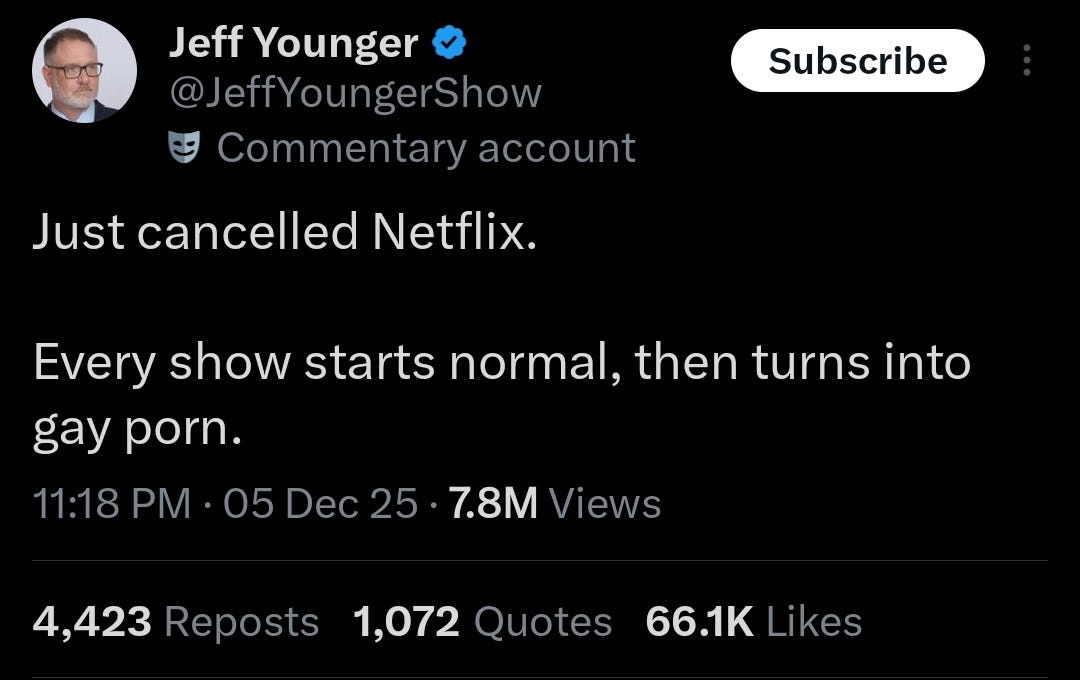
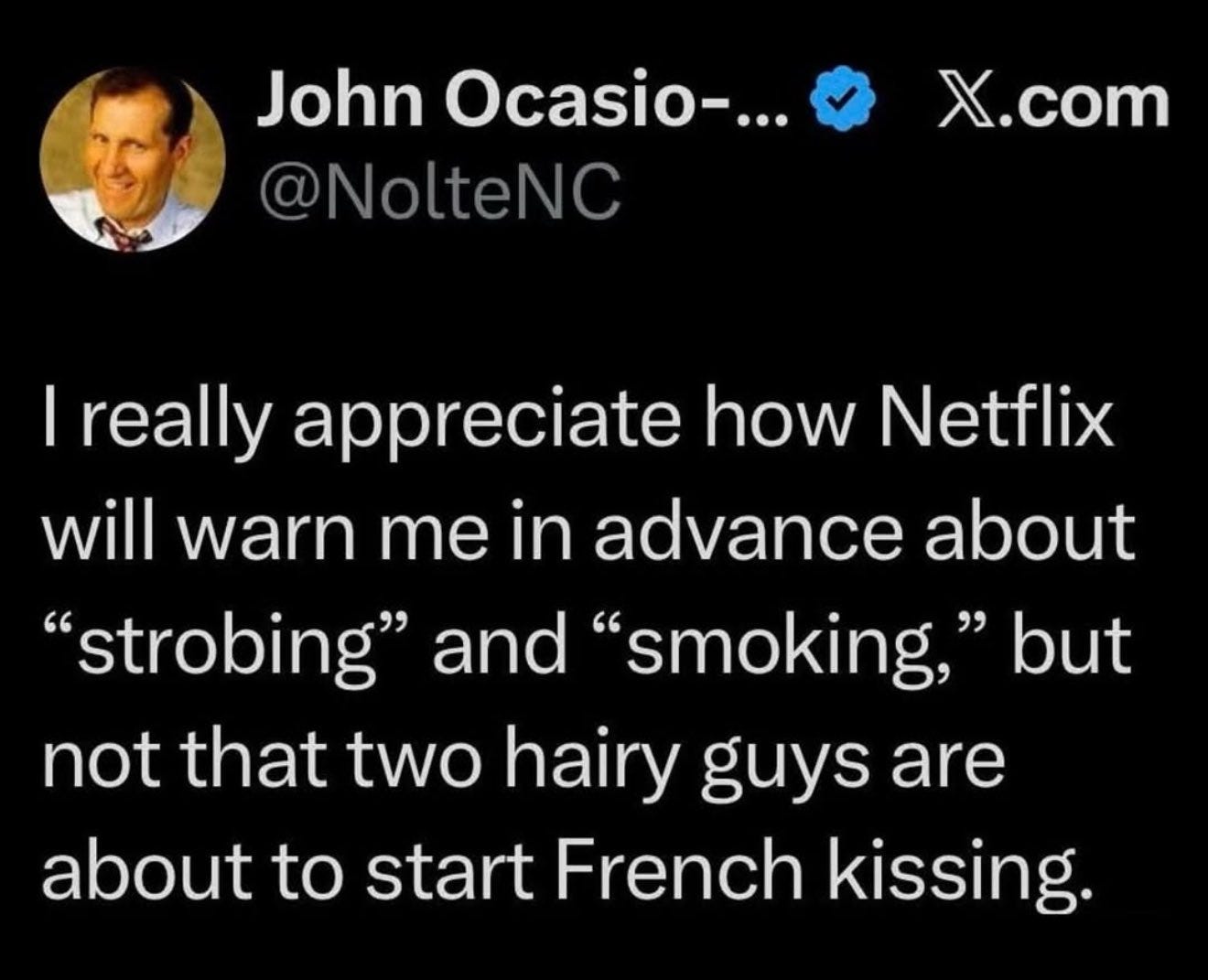
And his stories reify, amplify, perpetuate the metaphysical assumptions and visual iconography and deceitful interpretations of human desire, human biology, human aspirations, human psychology, human sexuality which he is on some level attempting to rebel against. We see the familiar motifs of Globohomo: cosmopolitan, deracinated urban cohorts; lesbian Girlboss strivers with fake prestige careers; vapid hedonistic promiscuity accompanied by sterility, sex without reproduction; ugliness and obesity promoted on every streetcorner; interracial relationships inserted randomly into every scene without comment; homosexual kissing onscreen (the justification is that kissing strangers of any sex is a way for the alien parasites to transmit their virus); out-of-shape women MOGging male nerds at basic science and math; disheveled clothes and poorly-dressed crowds, elevating disorder and entropy to promote an inverse hierarchy at the expense of the well-turned-out and beautiful.
These motifs are swiftly, efficiently glossed over… inserted briefly, or at the margins of the narrative, and if this messaging was not so ubiquitous for the past decade, I would have no idea what I’m looking at.
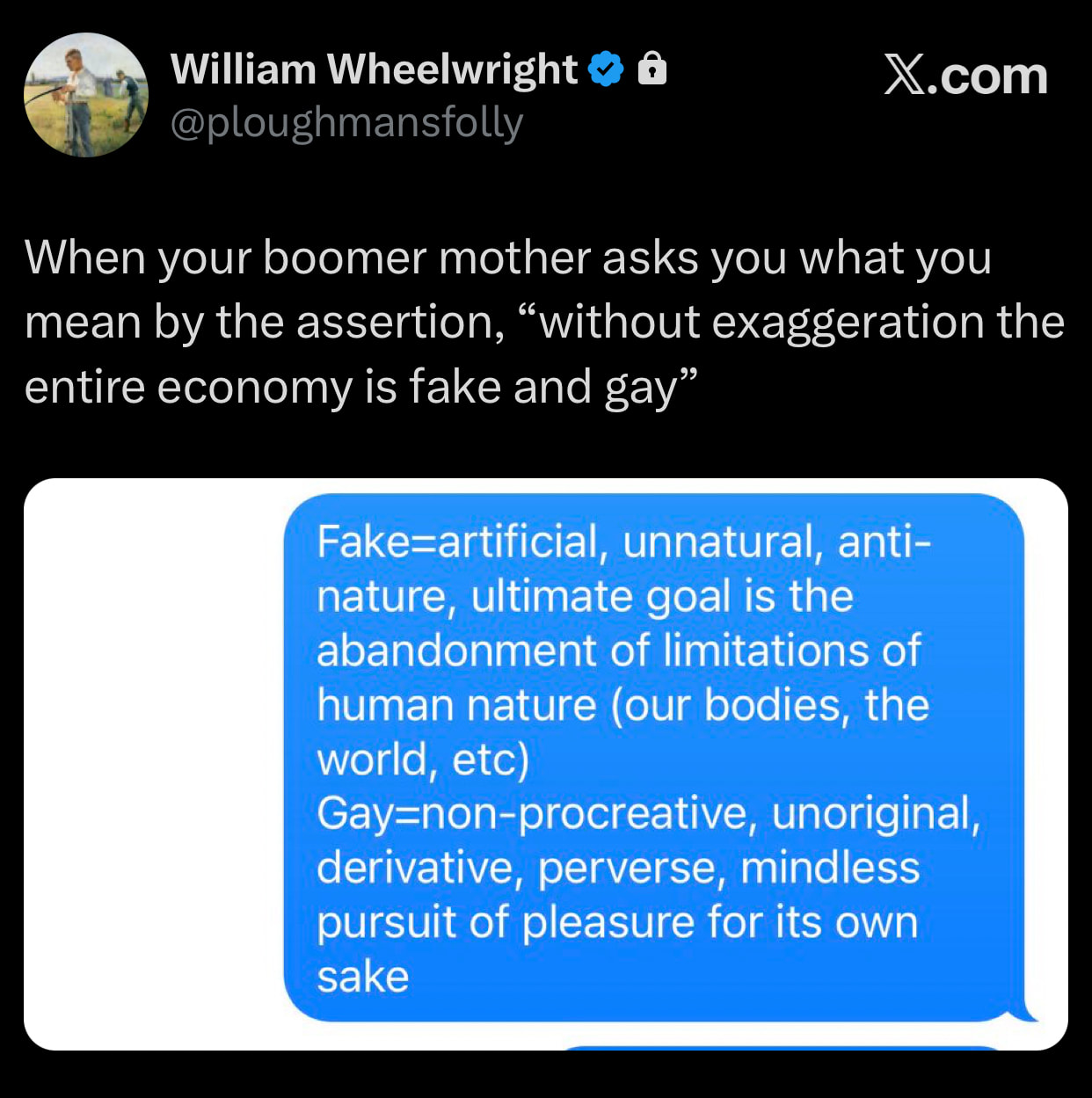
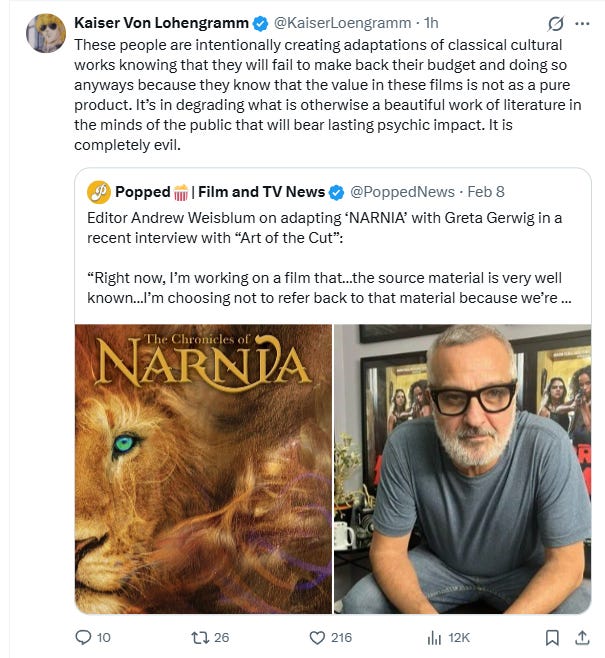

At the core, these ideas are artificial and illogical. They require constant propaganda and repetition in order to retain any semblance of normalcy. They are based on an inversion of reality, contradicting and clashing with anyone’s “lived experience”.
Someday these ideas will end, the institutional promotion of inverse hierarchy to further parasitic extraction, immiseration, and subordination of the productive classes.
All of this is brittle, it’s fragile, and it will fall apart as fast as the money laundering schemes of USAids when the money is cut. It’s all going to end. There is no remaining enthusiasm for this Utopian ideology which has inflicted so much damage on Western civilization, wrecked and ruined so many individual lives, careers, marriages, families, churches, companies, and communities.
And when these ideas end, nobody in 30 years, 40 years, 50 years looking back on a show like “Pluribus” will have any understanding of what the motifs, symbols, metaphysical assumptions, and visual iconography of Leftism were trying to argue, from even a detached intellectual, theoretical discussion.
This entire dialectic will be completely foreign, and illegible to future generations.
It’s fake, and it only endures so long as a massive propaganda apparatus holds it up. None of these ideas can stand on their own. None of these beliefs can survive a moment of vigorous scrutiny.
They are dodo birds, unable to take a challenge, unable to fend off a hungry predator.
Carol’s struggle is that she is a contrarian; she can see outside of the crowd, she can see where all of this is going (nowhere good), and she is attempting to find some way to remain comfortable while escaping assimilation into the suicidal death cult hive mind. All of this is autobiographical, from the perspective of Vince Gilligan.
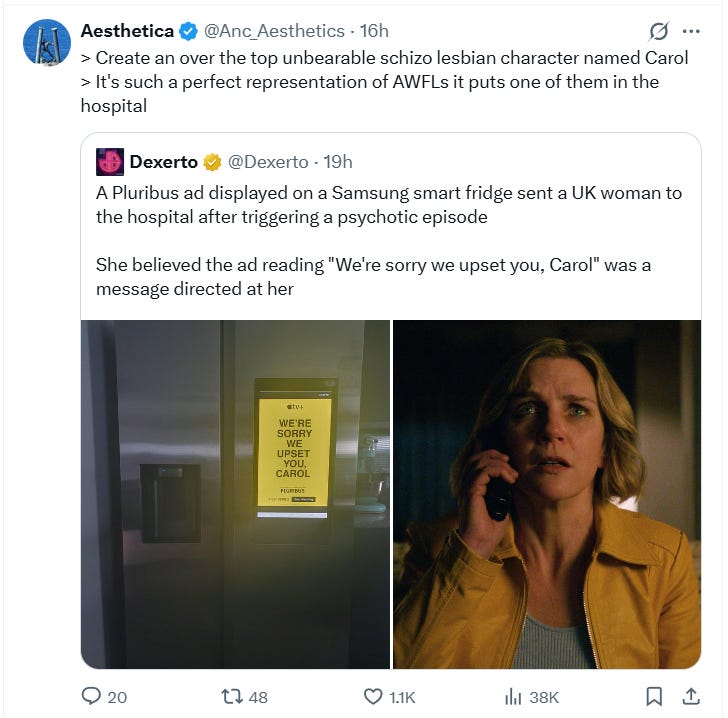
Carol herself is an abrasive, Girlboss parody of masculinity. She is deeply unpleasant, rages at the smallest impulse, and bitterly complains at every opportunity; this is presented as female “strength”.
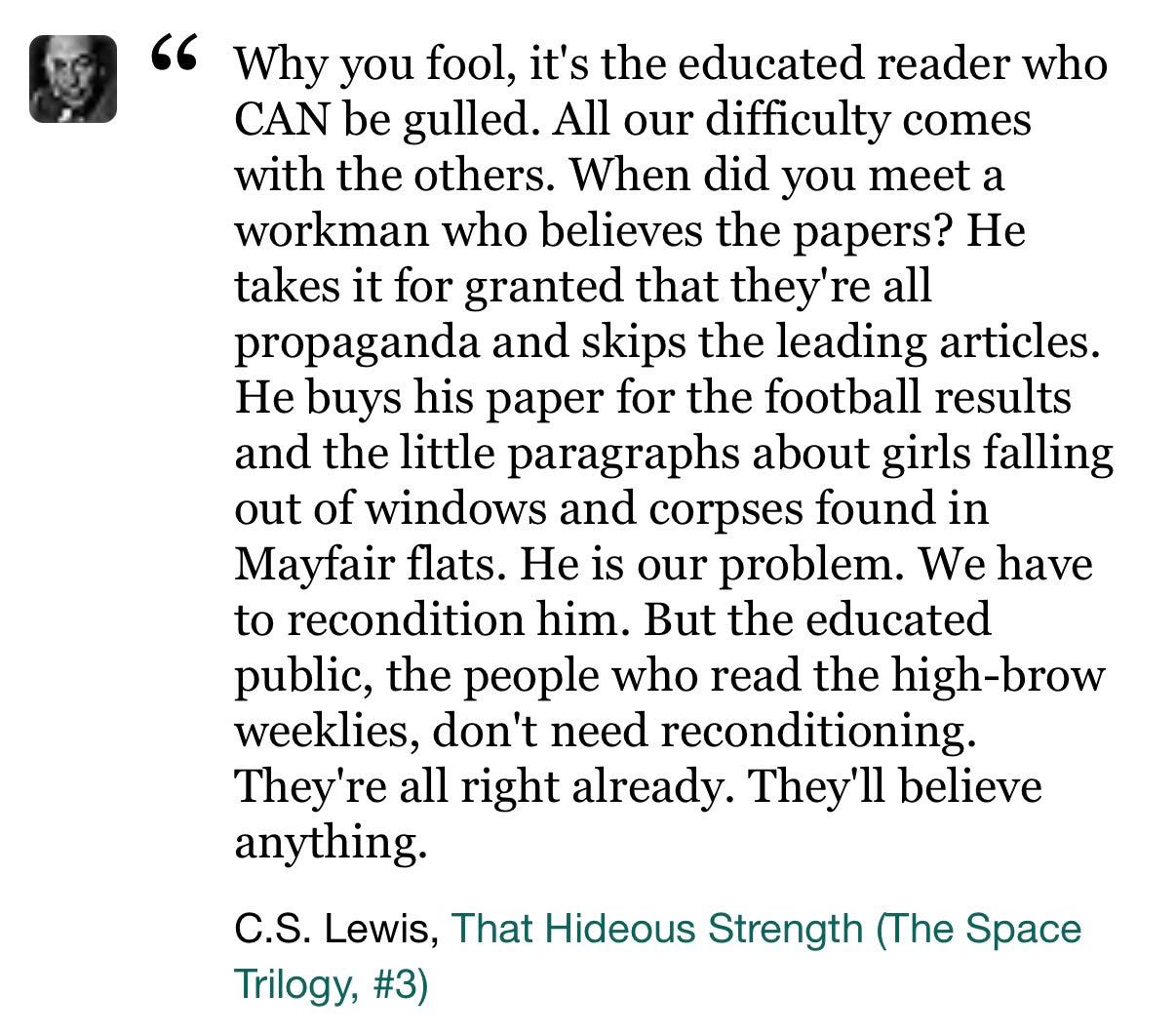
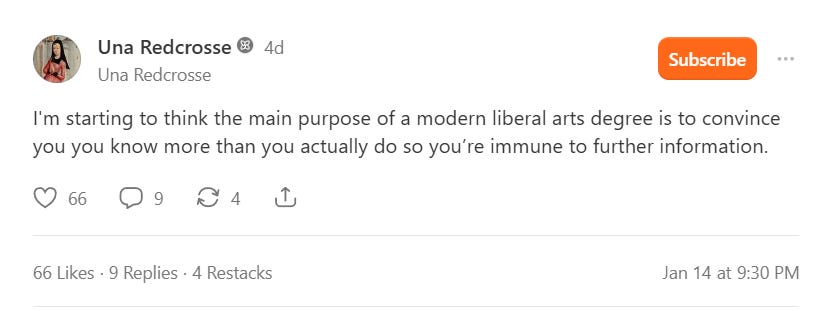
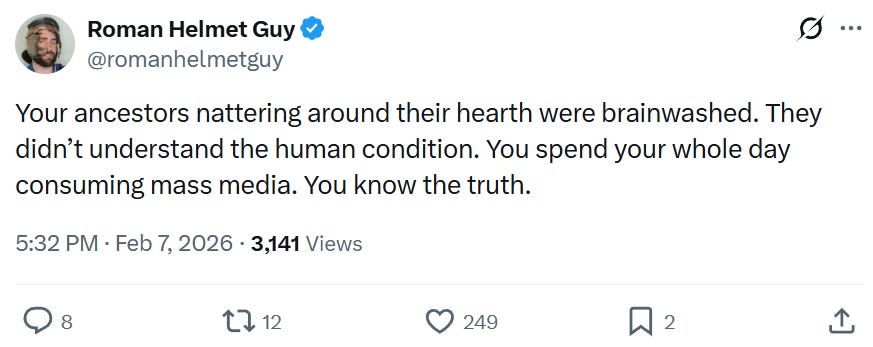
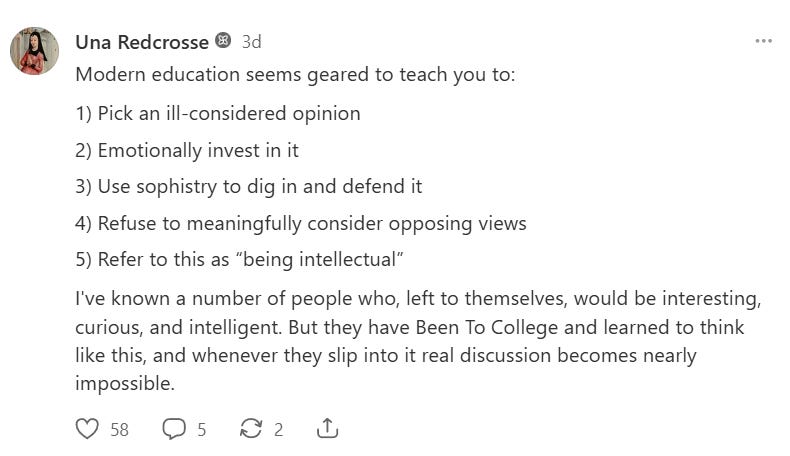
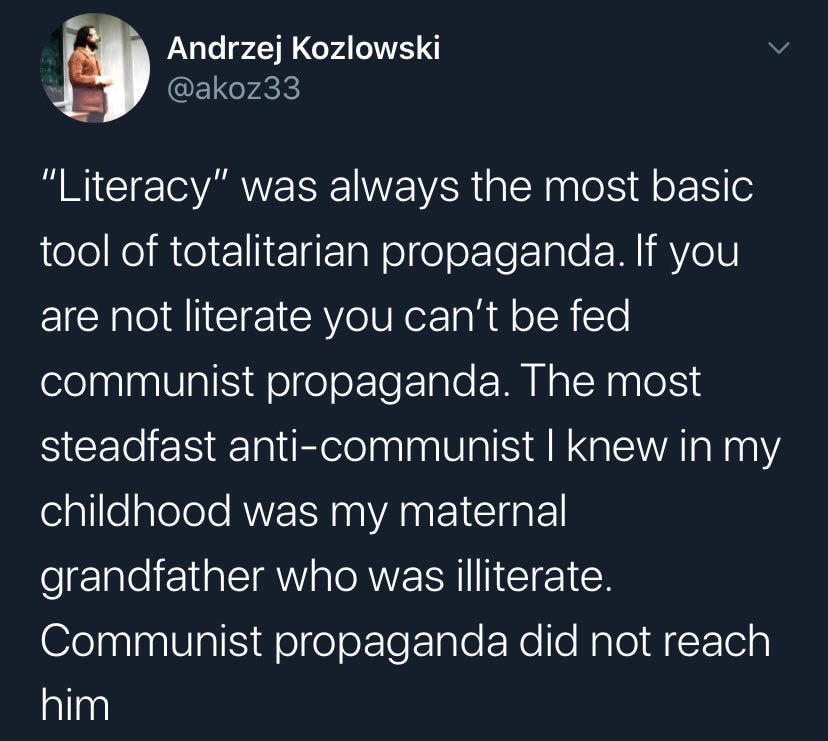
Perhaps “Pluribus” is simply a description of how any society runs at scale.
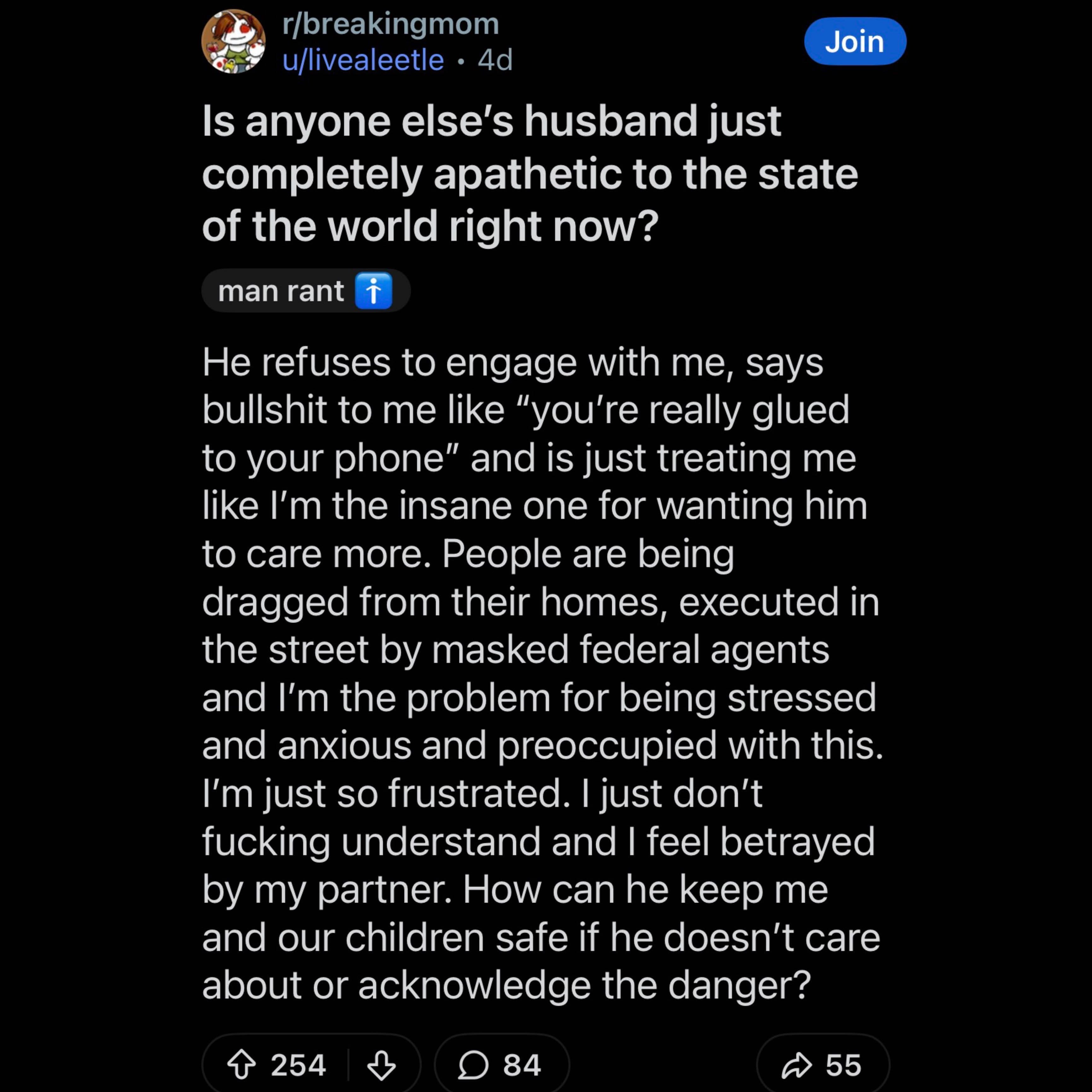
The nation-state is an artificial construct; loyalties are stretched beyond family, tribe, city, region, or racial group. Multiethnic empires need a shared culture to unify disparate groups. The propaganda state is necessary to provide a narrative glue. Wokeness is more noticeable because it’s a dishonest and inhuman narrative, a suicidal death cult that praises ugliness and elevates an inverse hiearchy. A propaganda state would feel as natural as fishes swimming in water if it aligned with what people already desired on their own, and the propaganda of the post-WW2 GI Bill and Levittown homes which was aimed at the returning veterans of World War Two must have resonated with genuine ardor.
The biggest misunderstanding of WW2 is the conventional wisdom that the capitalist liberal-democracy of American freedom, Germany’s Nazi Third Reich, Imperial Japan, and the Soviet Union represented different ideologies. Their aesthetics were very different. But structurally, these governments were in many respects identical. All of them were different strains of managerial state, or propaganda state, or modern empire. They all relied upon television, newspaper, radio, and magazine to pump out a shared narrative. Their organizational methods of mass conscription and mass mobilization were similar varieties of flocking behavior, embodying the kind of hivemind portrayed in “Pluribus”.
There is definitely an insanity to this organizational structure, and the isolation of being a contrarian while everyone else around you is seized by the euphoria and religious ecstasy of a shared delusion.
The definitive analysis of this social phenomenon was written by the President of Czechoslovakia, Vaclav Havel.
Christian Heiens, January 17th, 2025:
“Nearly every major Leftist victory of the last century follows the same exact playbook of turning some sort of boundary (national borders, the definition of marriage, the biological definition of sex, etc) that was considered universally accepted for the last 5,000 years of civilization into a moral problem.
From there, Leftists then would delegitimize any attempt to enforce the very thing that was taken for granted until five minutes ago by exhausting its defenders through endless moral outrage and ridiculous levels of hyperbolic accusation (“Deportations are a form of human trafficking!” “Having borders is Hitler!” “Trans genocide!”)
And what’s shocking about this is not how absurd it all seems when looking at it from the outside (it obviously was), but rather that it worked so well.
This model was almost flawless for decades. It gave the Left everything from feminism to gay marriage. And perhaps because it had such a stellar track record of racking up political wins, Leftists just naturally assumed they could deploy the progressive morality police as a sort of veto pen against any effort to undo their ideological agenda.
But what seems to be different this time is that the Right is finally willing to deny the Leftist premise entirely. They’re treating border enforcement and immigration law as things that are axiomatic rather than something that’s up for debate.
This is why the Left can’t turn ICE into a national justification for a 2020 style cultural revolution no matter how hard they’re currently trying. One side of the country just flat out refuses to grant them the moral legitimacy to burn the nation down.
And in doing so, we’re finally learning that the Leftist playbook only works so long as you grant them moral superiority. The second the Right responds with “you people are evil and your opinion is irrelevant”, the whole thing crumbles.”—Christian Heiens, January 17th, 2025:
One final comment about propaganda.
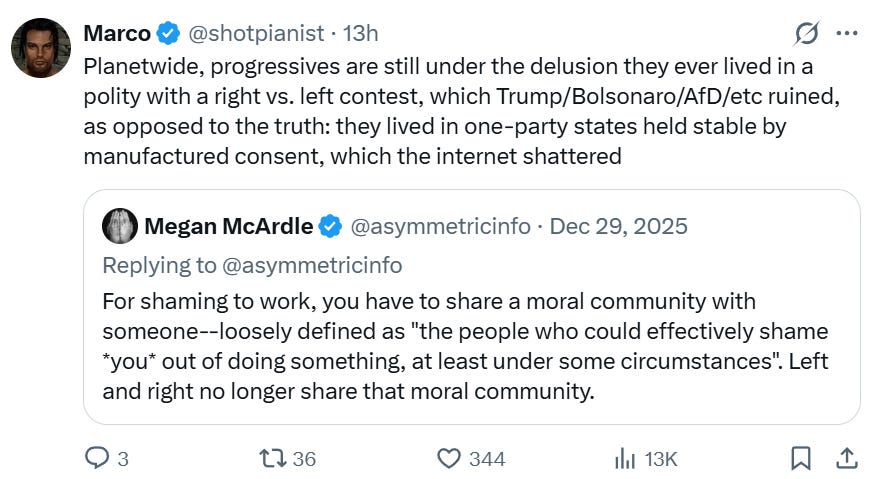
Nobody seems to understand how propaganda functions, which makes sense, because when it succeeds, it’s unconscious and automatic. But modern societies run on these flocking behaviors and mimetic infections. Political victories are downstream of cultural infections of the crowd’s psyche.
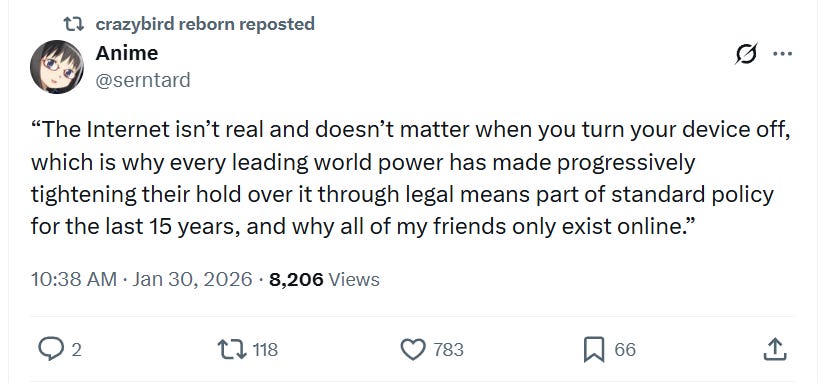
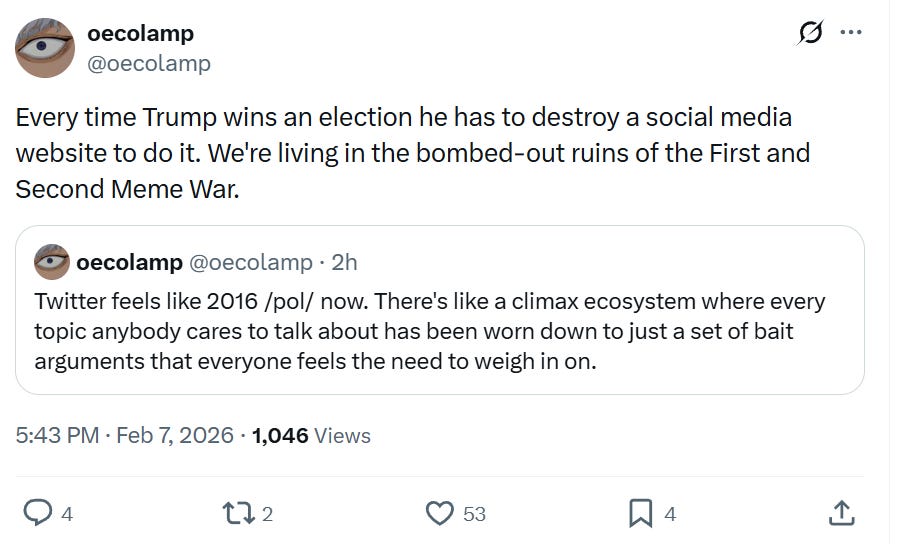
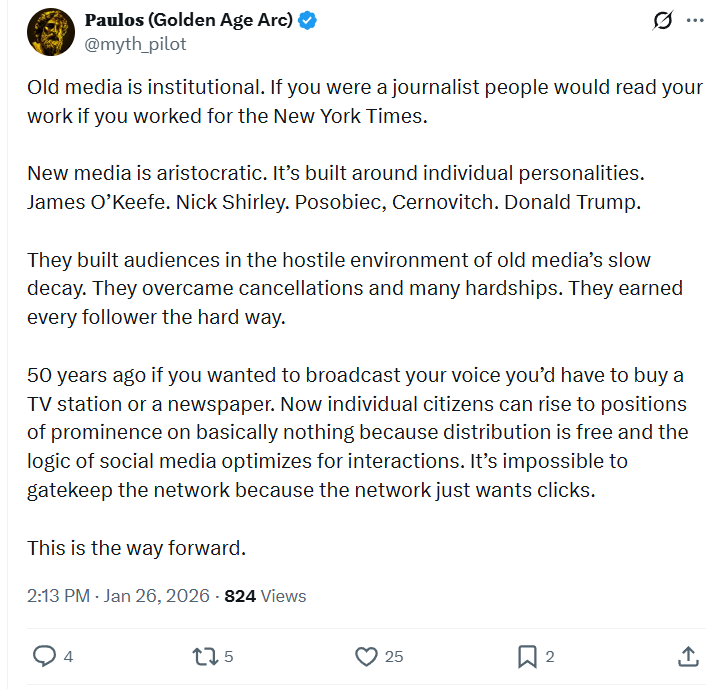
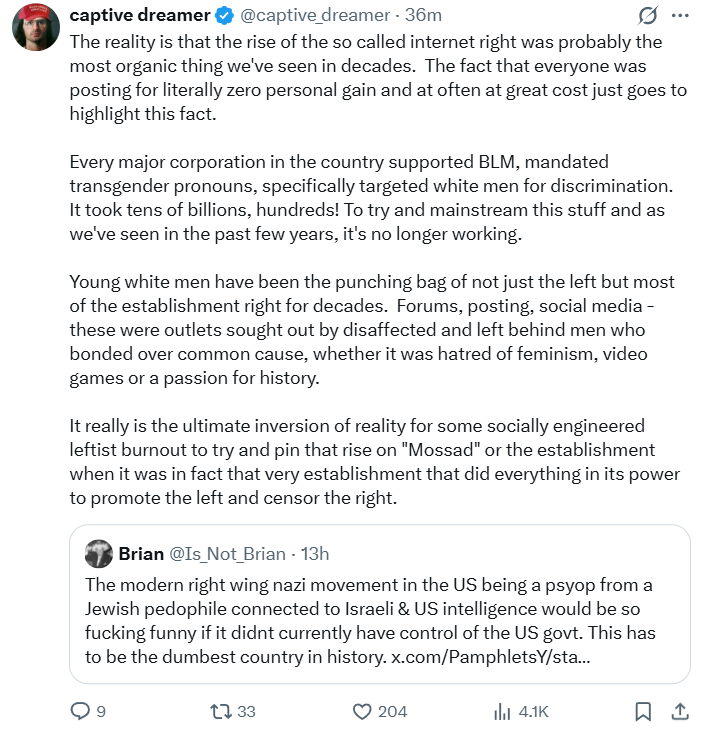
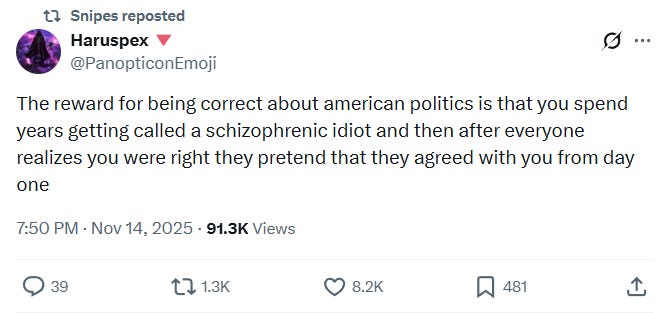
A lot of what we do online is seen as irrelevant — shouting into the void. We tweet, we write essays, we upload YouTube videos, we podcast interviews. None of it seems to make an impact. Sometimes important people retweet our best lines, or parrot our best insights, and we experience a brief euphoria of pushing the Overton window in a “Based” direction.
We talk about saving western civilization, and a lot of blackpillers show up in the comments section and say “Oh you’re all talk, you’re not going to do anything, why aren’t you out there with a rifle shooting [insert scapegoat] to save America?”
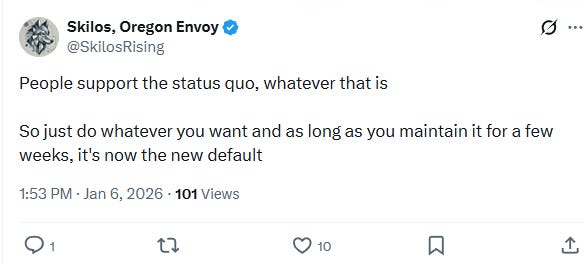
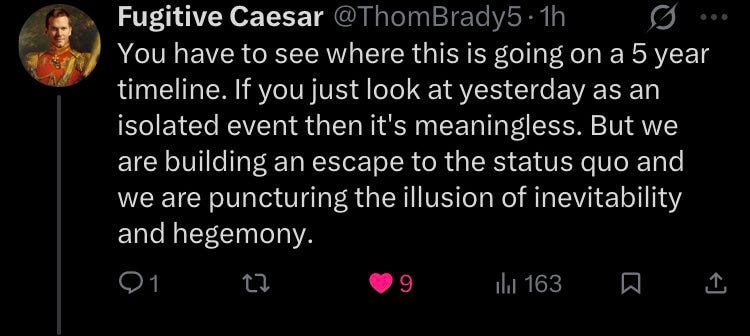
But the whole point of a preference cascade is that it requires propaganda. We win by planting our flag in the dirt, drawing a line in the sand, and refusing to move. What persuades people is not the initial act of planting a flag in the sand, but the subsequent series of events, watching as someone stubbornly defends the flag planted in the dirt. Nobody wants to take a risky position. Politicians don’t want to stake their careers on a fringe, low-status viewpoint. We win by clowning on our enemies and critiquing our rivals. We win by creating a permission structure that builds an alternative form of legitimacy. We win by expressing high-value solutions to high-value men, who either are rich and powerful, or are connected, or are on the verge of becoming rich, powerful, and connected. Intellectual trends filter down slowly from elite men (this is also why appealing to women is a waste of time; women will copycat the ideas of the strong, whereas diluting our value proposition to cater to the centrists and moderates is a self-defeating tactic).
One man with a rifle, even John Wick, is not enough to change the course of civilization. At scale, the modern, centralized state runs on ideology, beliefs, rituals, memes, and social consensus. The whole point of pushing forward aggressive ideas is to echo back and forth a new intellectual paradigm, and then to demonstrate ferociously that we are able to confidently, unapologetically defend that position with zero remorse and zero concessions.
Shytpoasting starts out as an act of self-expression, first and foremost, when you are dissecting and examining your own belief system in pursuit of higher truths. It’s an act of rebellion, escape, and self-discovery, seeking an outlet from the suppression and conformity of public life. But as it grows, it becomes a way to filter dangerous and radical ideas into the mainstream.
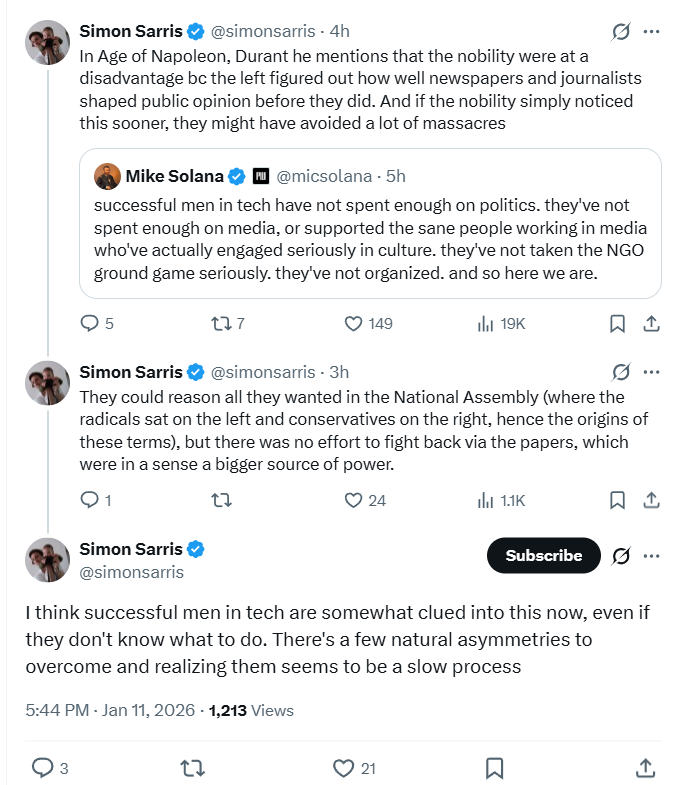
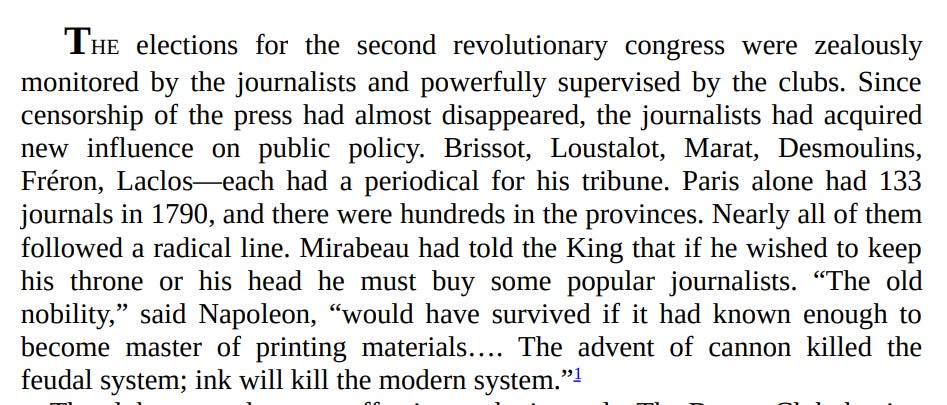
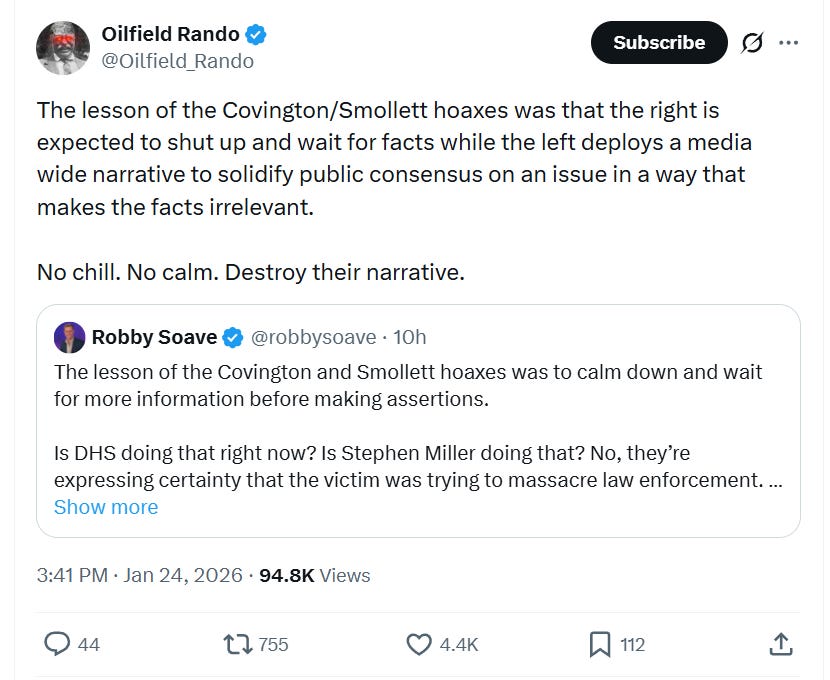
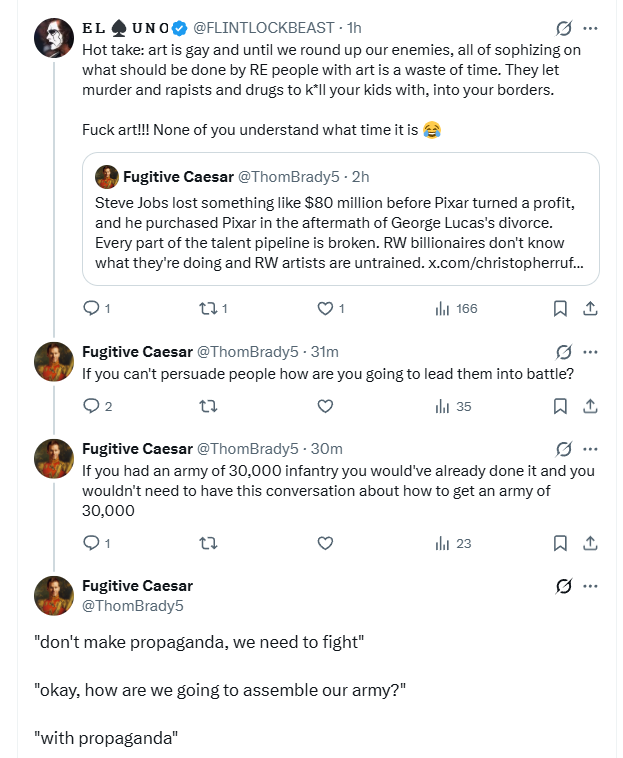
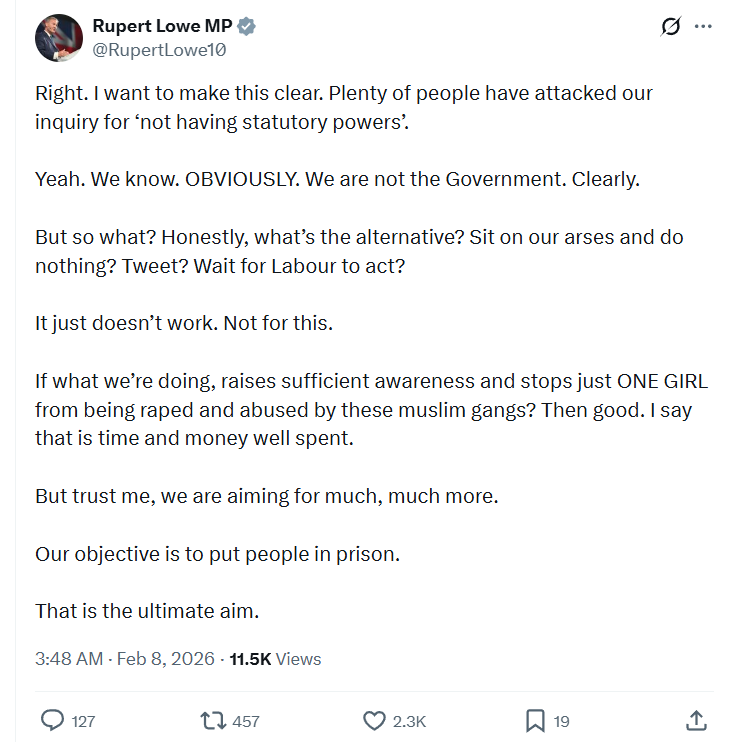
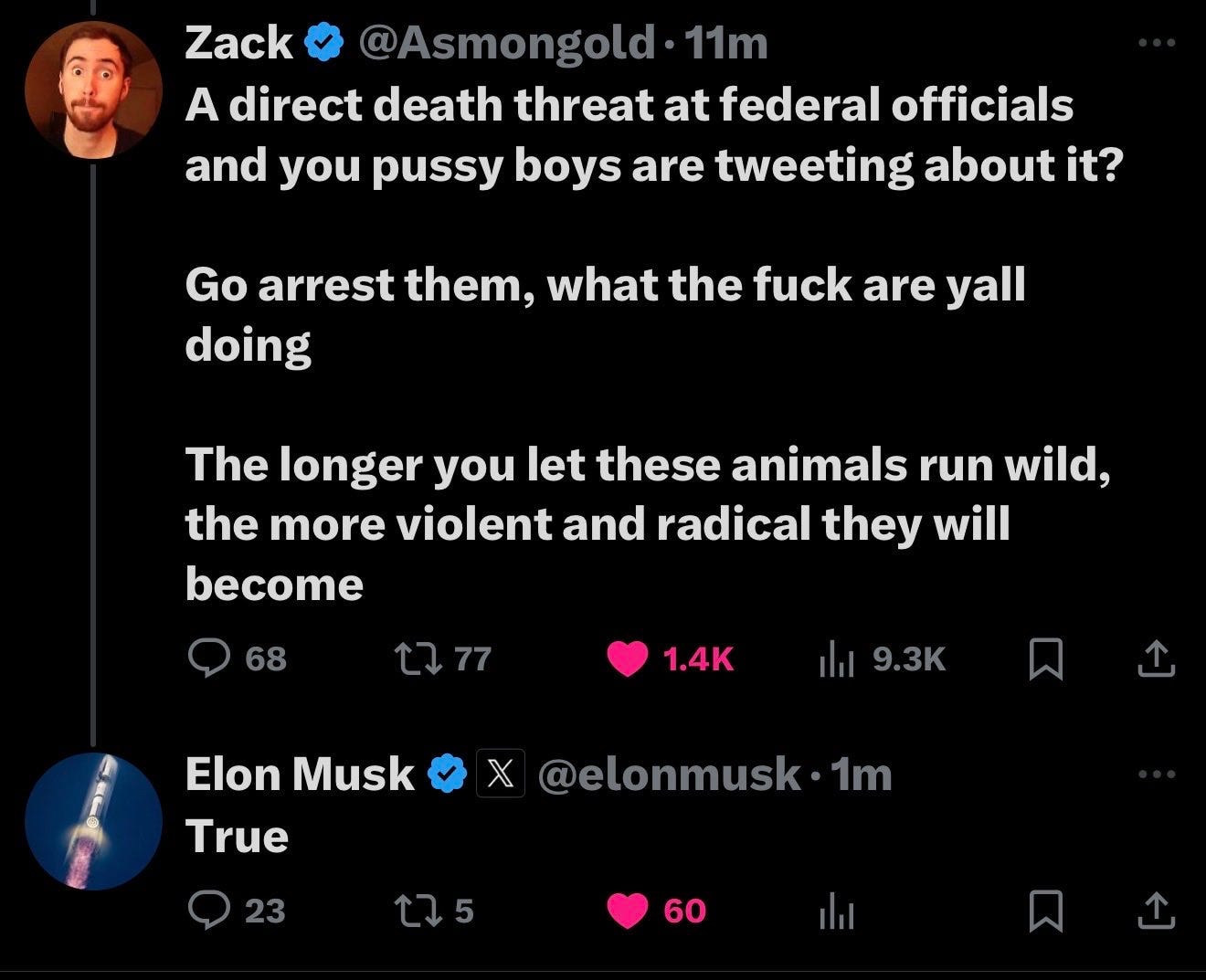
All of these tweets, essays, podcasts, and videos are a social mechanism similar to ant pheromones, signaling up and down the body of the hive, sending data from the periphery to the network’s core. We critique Elon Musk, or Donald Trump, or the various government departments for tweeting instead of making arrests and prosecutions. And our critiques are also part of the process; their tweets are asserting a position, and our aggression urges them to go harder. On some level, the RW Regime is sadly young and immature, and the question is whether our movement can grow up fast enough to stop the country falling apart, whether we can save young men before the $38 trillion in national debt implodes, whether we can race ahead of an impending civil war to stabilize the country and prevent widespread violence. Our stress is that the situation is dire and everything is falling apart and the actions we are taking today were necessary 20 years ago but now everything seems too small, too late, too tentative to achieve victory.
Shytpoasting is not a substitute for life. Life goes on, always. But propaganda is a precursor, a precondition to action. It’s not empty talk; or at least, what starts out as empty talk has the potential to become something very serious, as the message circulates across an interested, hungry audience. Action is better than talk, but planting the flag only works if you are able to defend your position from the immediate, inevitable reprisals that will be provoked when you claim new territory. Action produces a salient; if you overextend the salient, you will be deplatformed, or banned, or arrested, or fired from your job. This is ideological trench warfare, it’s slow-going, but also, when the enemy front collapses, that salient must be pushed as far and fast and aggressively as possible in order to capitalize on the routed enemy and strike harder and harder and harder before the enemy can regroup and fortify their fallback positions.
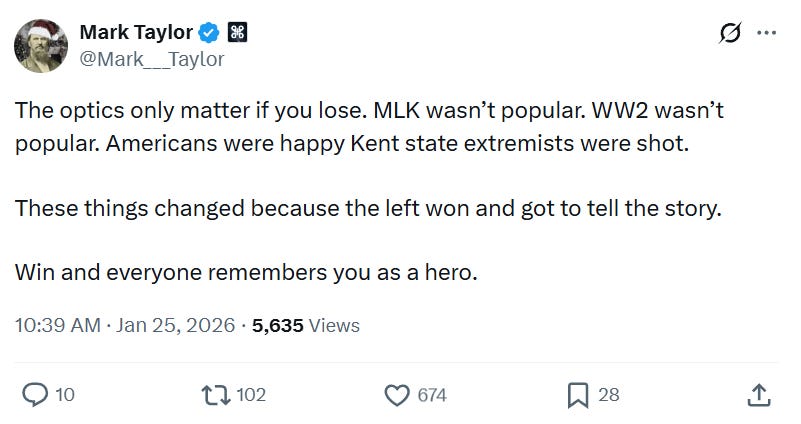
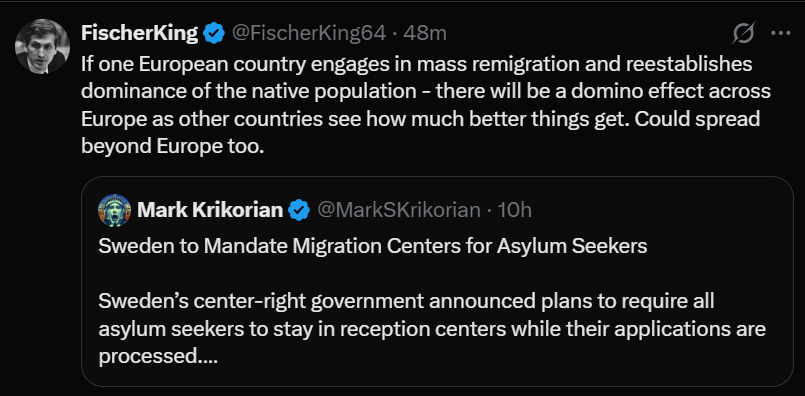
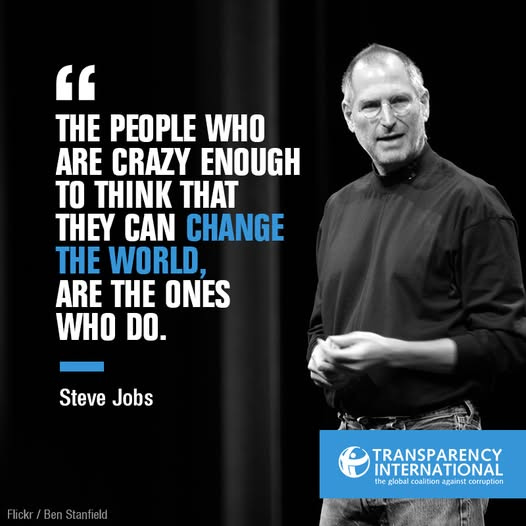
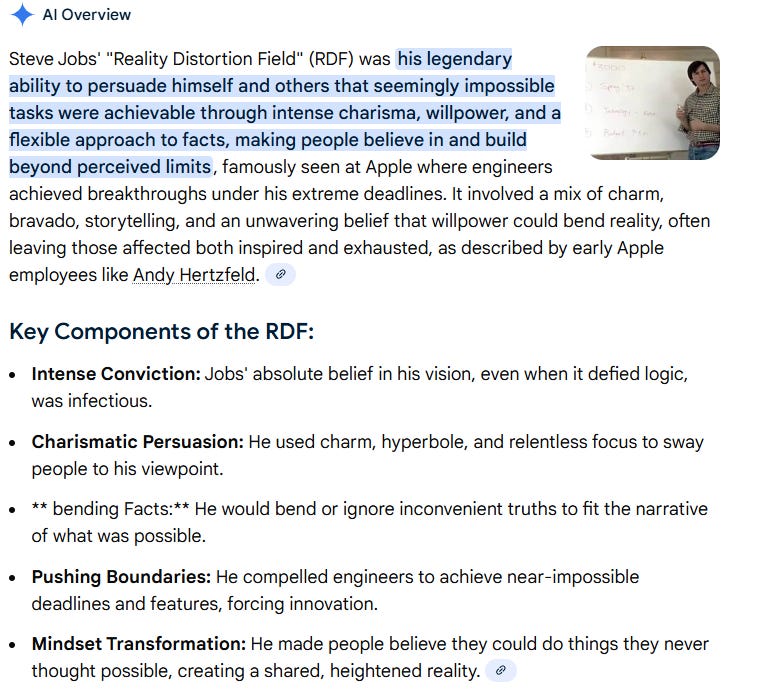
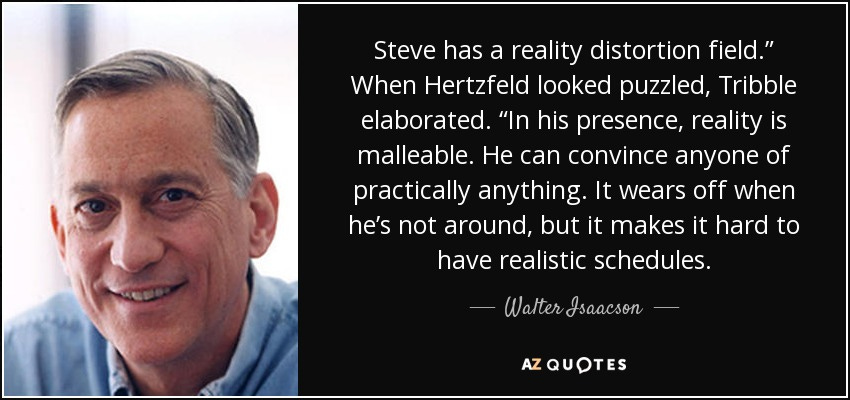
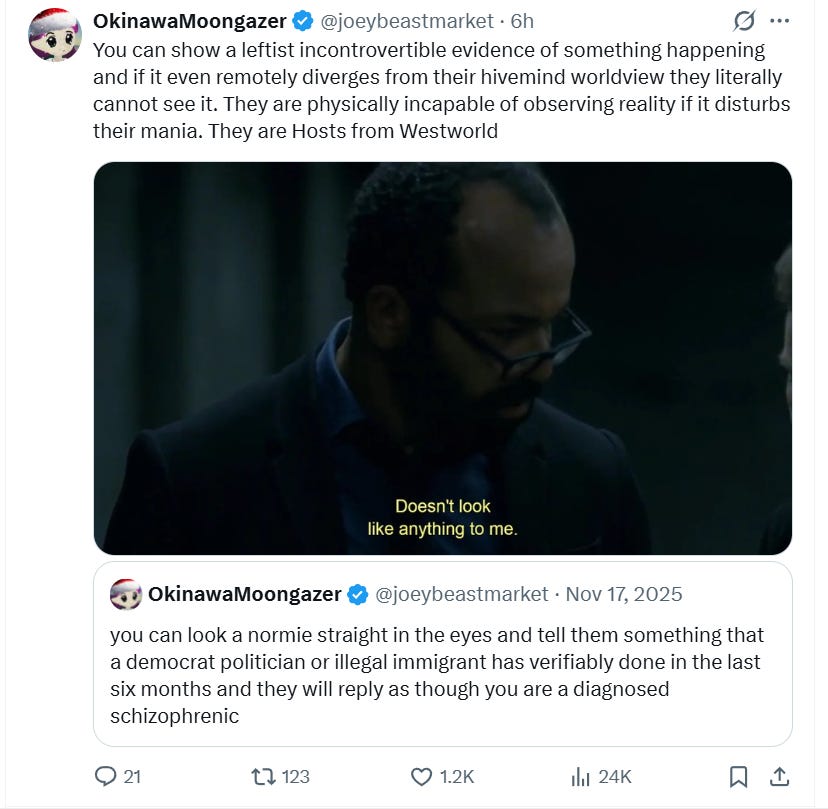
The important thing is to stack victories, and to build tangible wins that will make the next series of wins easier: deporting any foreigners on welfare is a strong, textbook example of how to hammer a winning issue. It doesn’t make sense to import millions of useless people and give them free money and medical treatments. And deportations salami slice the Democrat coalition. Every deportation raises wages, lowers housing costs, frees up jobs, and lowers crime for American citizens. Every deportation cuts funding from Democrats, weakens their voter turnout, demoralizes their tribe, and reduces their military power, stripping the available pool of military age males.
Vaclav Havel’s analysis is educational in terms of reverse-engineering how these patterns develop, and can be challenged, or repurposed for our own crusades.
Vaclav Havel, The Power of the Powerless:
“The system… is totalitarian in a way fundamentally different from classical dictatorships, different from totalitarianism as we usually understand it.
…
The manager of a fruit-and-vegetable shop places in his window, among the onions and carrots, the slogan:
“Workers of the world, unite!”
Why does he do it? What is he trying to communicate to the world? Is he genuinely enthusiastic about the idea of unity among the workers of the world? Is his enthusiasm so great that he feels an irrepressible impulse to acquaint the public with his ideals? Has he really given more than a moment’s thought to how such a unification might occur and what it would mean? I think it can safely be assumed that the overwhelming majority of shopkeepers never think about the slogans they put in their windows, nor do they use them to express their real opinions. That poster was delivered to our greengrocer from the enterprise headquarters along with the onions and carrots.
He put them all into the window simply because it has been done that way for years, because everyone does it, and because that is the way it has to be. If he were to refuse, there could be trouble. He could be reproached for not having the proper decoration in his window; someone might even accuse him of disloyalty. He does it because these things must be done if one is to get along in life. It is one of the thousands of details that guarantee him a relatively tranquil life “in harmony with society,” as they say.
Obviously the greengrocer is indifferent to the semantic content of the slogan on exhibit; he does not put the slogan in his window from any personal desire to acquaint the public with the ideal it expresses. This, of course, does not mean that his action has no motive or significance at all, or that the slogan communicates nothing to anyone. The slogan is really a sign, and as such it contains a subliminal but very definite message. Verbally, it might be expressed this way: “I, the greengrocer XY, live here and I know what I must do. I behave in the manner expected of me. I can be depended upon and am beyond reproach. I am obedient and therefore I have the right to be left in peace.”
This message, of course, has an addressee: it is directed above, to the greengrocer’s superior, and at the same time it is a shield that protects the greengrocer from potential informers. The slogan’s real meaning, therefore, is rooted firmly in the greengrocer’s existence. It reflects his vital interests.
But what are those vital interests?
Let us take note: if the greengrocer had been instructed to display the slogan “I am afraid and therefore unquestioningly obedient,” he would not be nearly as indifferent to its semantics, even though the statement would reflect the truth. The greengrocer would be embarrassed and ashamed to put such an unequivocal statement of his own degradation in the shop window, and quite naturally so, for he is a human being and thus has a sense of his own dignity. To overcome this complication, his expression of loyalty must take the form of a sign which, at least on its textual surface, indicates a level of disinterested conviction. It must allow the greengrocer to say, “Whats wrong with the workers of the world uniting?”
Thus the sign helps the greengrocer to conceal from himself the low foundations of his obedience, at the same time concealing the low foundations of power. It hides them behind the facade of something high. And that something is ideology.
Ideology is a specious way of relating to the world.
It offers human beings the illusion of an identity, of dignity, and of morality while making it easier for them to part with them. As the repository of something suprapersonal and objective, it enables people to deceive their conscience and conceal their true position and their in glorious modus vivendi, both from the world and from themselves.
It is a very pragmatic but, at the same time, an apparently dignified way of legitimizing what is above, below, and on either side. It is directed toward people and toward God. It is a veil behind which human beings can hide their own fallen existence, their trivialization, and their adaptation to the status quo. It is an excuse that every one can use, from the greengrocer, who conceals his fear of losing his job behind an alleged interest in the unification of the workers of the world, to the highest functionary, whose interest in staying in power can be cloaked in phrases about service to the working class.
The primary excusatory function of ideology, therefore, is to provide people, both as victims and pillars of the post-totalitarian system, with the illusion that the system is in harmony with the human order and the order of the universe. The smaller a dictatorship and the less stratified by modernization the society under it, the more directly the will of the dictator can be exercised- In other words, the dictator can employ more or less naked discipline, avoiding the complex processes of relating to the world and of self-justification which ideology involves.
But the more complex the mechanisms of power become, the larger and more stratified the society they embrace, and the longer they have operated historically, the more individuals must be connected to them from outside, and the greater the importance attached to the ideological excuse. It acts as a kind of bridge between the regime and the people, across which the regime approaches the people and the people approach the regime.
This explains why ideology plays such an important role in the post-totalitarian system: that complex machinery of units, hierarchies, transmission belts, and indirect instruments of manipulation which ensure in countless ways the integrity of the regime, leaving nothing to chance, would be quite simply unthinkable without ideology acting as its all-embracing excuse and as the excuse for each of its parts.
Between the aims of the post-totalitarian system and the aims of life there is a yawning abyss: while life, in its essence, moves toward plurality, diversity, independent self-constitution, and self-organization, in short, toward the fulfillment of its own freedom, the post-totalitarian system demands conformity, uniformity, and discipline. While life ever strives to create new and improbable structures, the posttotalitarian system contrives to force life into its most probable states.
The aims of the system reveal its most essential characteristic to be introversion, a movement toward being ever more completely and unreservedly itself, which means that the radius of its influence is continually widening as well. This system serves people only to the extent necessary to ensure that people will serve it. Anything beyond this, that is to say, anything which leads people to overstep their predetermined roles is regarded by the system as an attack upon itself. And in this respect it is correct: every instance of such transgression is a genuine denial of the system.
It can be said, therefore, that the inner aim of the post-totalitarian system is not mere preservation of power in the hands of a ruling clique, as appears to be the case at first sight. Rather, the social phenomenon of self-preservation is subordinated to something higher, to a kind of blind automatism which drives the system. No matter what position individuals hold in the hierarchy of power, they are not considered by the system to be worth anything in themselves, but only as things intended to fuel and serve this automatism.
For this reason, an individual’s desire for power is admissible only insofar as its direction coincides with the direction of the automatism of the system. Ideology, in creating a bridge of excuses between the system and the individual, spans the abyss between the aims of the system and the aims of life. It pretends that the requirements of the system derive from the requirements of life. It is a world of appearances trying to pass for reality.
The post-totalitarian system touches people at every step, but it does so with its ideological gloves on.
This is why life in the system is so thoroughly permeated with hypocrisy and lies: government by bureaucracy is called popular government; the working class is enslaved in the name of the working class; the complete degradation of the individual is presented as his ultimate liberation; depriving people of information is called making it available; the use of power to manipulate is called the public control of power, and the arbitrary abuse of power is called observing the legal code; the repression of culture is called its development; the expansion of imperial influence is presented as support for the oppressed; the lack of free expression becomes the highest form of freedom; farcical elections become the highest form of democracy; banning independent thought becomes the most scientific of worldviews; military occupation becomes fraternal assistance.
Because the regime is captive to its own lies, it must falsify everything. It falsifies the past. It falsifies the present, and it falsifies the future. It falsifies statistics. It pretends not to possess an omnipotent and unprincipled police apparatus. It pretends to respect human rights. It pretends to persecute no one. It pretends to fear nothing. It pretends to pretend nothing.
Individuals need not believe all these mystifications, but they must behave as though they did, or they must at least tolerate them in silence, or get along well with those who work with them. For this reason, however, they must live within a lie. They need not accept the lie. It is enough for them to have accepted their life with it and in it.
For by this very fact, individuals confirm the system, fulfill the system, make the system, are the system.
We have seen that the real meaning of the greengrocer’s slogan has nothing to do with what the text of the slogan actually says. Even so, this real meaning is quite clear and generally comprehensible because the code is so familiar: the greengrocer declares his loyalty (and he can do no other if his declaration is to be accepted) in the only way the regime is capable of hearing; that is, by accepting the prescribed ritual, by accepting appearances as reality, by accepting the given rules of the game. In doing so, however, he has himself become a player in the game, thus making it possible for the game to go on, for it to exist in the first place. If ideology was originally a bridge between the system and the individual as an individual, then the moment he steps on to this bridge it becomes at the same time a bridge between the system and the individual as a component of the system.
That is, if ideology originally facilitated (by acting outwardly) the constitution of power by serving as a psychological excuse, then from the moment that excuse is accepted, it constitutes power inwardly, becoming an active component of that power. It begins to function as the principal instrument of ritual communication within the system of power. The whole power structure (and we have already discussed its physical articulation) could not exist at all if there were not a certain metaphysical order binding all its components together, in interconnecting them and subordinating them to a uniform method of accountability, supplying the combined operation of all these components with rules of the game, that is, with certain regulations, limitations, and legalities. This metaphysical order is fundamental to, and standard throughout, the entire power structure; it integrates its communication system and makes possible the internal exchange and transfer of information and instructions.
It is rather like a collection of traffic signals and directional signs, giving the process shape and structure.
This metaphysical order guarantees the inner coherence of the totalitarian power structure. It is the glue holding it together, its binding principle, the instrument of its discipline. Without this glue the structure as a totalitarian structure would vanish; it would disintegrate into individual atoms chaotically colliding with one another in their unregulated particular interests and inclinations.
…
Whereas succession to power in classical dictatorship is always a rather complicated affair (the pretenders having nothing to give their claims reasonable legitimacy, thereby forcing them always to resort to confrontations of naked power), in the post-totalitarian system power is passed on from person to person, from clique to clique, and from generation to generation in an essentially more regular fashion.
In the selection of pretenders, a new “king-maker” takes part: it is ritual legitimation, the ability to rely on ritual, to fulfill it and use it, to allow oneself, as it were, to be borne aloft by it. Naturally, power struggles exist in the post totalitarian system as well, and most of them are far more brutal than in an open society, for the struggle is not open, regulated by democratic rules, and subject to public control, but hidden behind the scenes. (It is difficult to recall a single instance in which the First Secretary of a ruling Communist Party has been replaced without the various military and security forces being placed at least on alert.)
This struggle, however, can never (as it can in classical dictatorships) threaten the very essence of the system and its continuity.
At most it will shake up the power structure, which will recover quickly precisely because the binding substance-ideology remains undisturbed. No matter who is replaced by whom, succession is only possible against the backdrop and within the framework of a common ritual. It can never take place by denying that ritual.
Because of this dictatorship of the ritual, however, power becomes clearly anonymous. Individuals are almost dissolved in the ritual. They allow themselves to be swept along by it and frequently it seems as though ritual alone carries people from obscurity into the light of power.
Is it not characteristic of the post-totalitarian system that, on all levels of the power hierarchy, individuals are increasingly being pushed aside by faceless people, puppets, those uniformed flunkeys of the rituals and routines of power?
The automatic operation of a power structure thus dehumanized and made anonymous is a feature of the fundamental automatism of this system. It would seem that it is precisely the diktats of this automatism which select people lacking individual will for the power structure, that it is precisely the diktat of the empty phrase which summons to power people who use empty phrases as the best guarantee that the automatism of the post-totalitarian system will continue.
Western Sovietologists often exaggerate the role of individuals in the post-totalitarian system and overlook the fact that the ruling figures, despite the immense power they possess through the centralized structure of power, are often no more than blind executors of the systems own internal laws — laws they themselves never can, and never do, reflect upon.
In any case, experience has taught us again and again that this automatism is far more powerful than the will of any individual; and should someone possess a more independent will, he must conceal it behind a ritually anonymous mask in order to have an opportunity to enter the power hierarchy at all.
And when the individual finally gains a place there and tries to make his will felt within it, that automatism, with its enormous inertia, will triumph sooner or later, and either the individual will be ejected by the power structure like a foreign organism, or he will be compelled to resign his individuality gradually, once again blending with the automatism and becoming its servant, almost indistinguishable from those who preceded him and those who will follow. (Let us recall, for instance, the development of Gustav Husak or Władysław Gomulka.)
The necessity of continually hiding behind and relating to ritual means that even the more enlightened members of the power structure are often obsessed with ideology. They are never able to plunge straight to the bottom of naked reality, and they always confuse it, in the final analysis, with ideological pseudoreality. (In my opinion, one of the reasons the Dubek leadership lost control of the situation in 1968 was precisely because, in extreme situations and in final questions, its members were never capable of extricating themselves completely from the world of appearances.)
It can be said, therefore, that ideology, as that instrument of internal communication which assures the power structure of inner cohesion is, in the posttotalitarian system, something that transcends the physical aspects of power, something that dominates it to a considerable degree and, therefore, tends to assure its continuity as well. It is one of the pillars of the systems external stability. This pillar, however, is built on a very unstable foundation. It is built on lies. It works only as long as people are willing to live within the lie.
Why in fact did our greengrocer have to put his loyalty on display in the shop window? Had he not already displayed it sufficiently in various internal or semipublic ways? At trade union meetings, after all, he had always voted as he should. He had always taken part in various competitions. He voted in elections like a good citizen. He had even signed the “antiCharter.” Why, on top of all that, should he have to declare his loyalty publicly?
After all, the people who walk past his window will certainly not stop to read that, in the greengrocer’s opinion, the workers of the world ought to unite.
The fact of the matter is, they don’t read the slogan at all, and it can be fairly assumed they don’t even see it. If you were to ask a woman who had stopped in front of his shop what she saw in the window, she could certainly tell whether or not they had tomatoes today, but it is highly unlikely that she noticed the slogan at all, let alone what it said. It seems senseless to require the greengrocer to declare his loyalty publicly.
But it makes sense nevertheless.
People ignore his slogan, but they do so because such slogans are also found in other shop windows, on lampposts, bulletin boards, in apartment windows, and on buildings; they are everywhere, in fact.
They form part of the panorama of everyday life. Of course, while they ignore the details, people are very aware of that panorama as a whole.
And what else is the greengrocers slogan but a small component in that huge backdrop to daily life? The greengrocer had to put the slogan in his window, therefore, not in the hope that someone might read it or be persuaded by it, but to contribute, along with thousands of other slogans, to the panorama that everyone is very much aware of. This panorama, of course, has a subliminal meaning as well: it reminds people where they are living and what is expected of them. It tells them what everyone else is doing, and indicates to them what they must do as well, if they don’t want to be excluded, to fall into isolation, alienate themselves from society, break the rules of the game, and risk the loss of their peace and tranquility and security.
The woman who ignored the greengrocer’s slogan may well have hung a similar slogan just an hour before in the corridor of the ice where she works. She did it more or less without thinking, just as our greengrocer did, and she could do so precisely because she was doing it against the background of the general panorama and with some awareness of it, that is, against the background of the panorama of which the greengrocers shop window forms a part.
When the greengrocer visits her office, he will not notice her slogan either, just as she failed to notice his. Nevertheless, their slogans are mutually dependent: both were displayed with some awareness of the general panorama and, we might say, under its diktat. Both, however, assist in the creation of that panorama, and therefore they assist in the creation of that diktat as well.
The greengrocer and the office worker have both adapted to the conditions in which they live, but in doing so, they help to create those conditions. They do what is done, what is to be done, what must be done, but at the same time—by that very token—they confirm that it must be done in fact. They conform to a particular requirement and in so doing they themselves perpetuate that requirement.
Metaphysically speaking, without the greengrocer’s slogan the office worker’s slogan could not exist, and vice versa. Each proposes to the other that something be repeated and each accepts the other’s proposal.
Their mutual indifference to each other’s slogans is only an illusion: in reality, by exhibiting their slogans, each compels the other to accept the rules of the game and to confirm thereby the power that requires the slogans in the first place. Quite simply, each helps the other to be obedient.
Both are objects in a system of control, but at the same time they are its subjects as well. They are both victims of the system and its instruments. If an entire district town is plastered with slogans that no one reads, it is on the one hand a message from the district secretary to the regional secretary, but it is also something more: a small example of the principle of social auto-totality at work.”
—Vaclav Havel, The Power of the Powerless
An often overlooked aspect of the psychological trauma of 2021: At the time, there was no reason to believe that any of it was ever going to end. That year, living in Seattle, I was prohibited from sitting inside restaurants and seeing my disabled wife in the hospital. More and more businesses were asking for a certain paper that I didn't have.
You couldn't walk maskless into a building without being confronted and asked to leave. Yes, resistance and all that, but resistance was getting emotionally exhausting. Resistance meant high cortisol levels and stress.
And there was no resisting in medical facilities. You were escorted out of the building by security and trespassed if you refused to leave. I had fake masks. I wore them. It felt completely absurd and ridiculous. As if I was living in "The Walking Dead" and had to wear a fake skin so that I could walk undetected among the Covidians.
In 2021 I had every reason to think that this would be my life FOREVER. That all of it could only get worse, and it would never get better.
When coach tells you to run one lap around the track, it's completely different than coach telling you to run until he says to stop. "Run until I say stop" was how it felt in Seattle in 2021.
Good post (if a bit too long). I’m not sure that the leftism of today will be forgotten or not understood, though. I think that part of the counter-revolution is an awareness of leftism as a psychological phenomenon. The left loves to psychoanalyze the right, but has largely escaped from similar scrutiny. As their world, worldview, and supporting systems collapse, their motives become more transparent. In the coming years it will become common knowledge that (e.g.) lots of leftism comes from father-hatred.